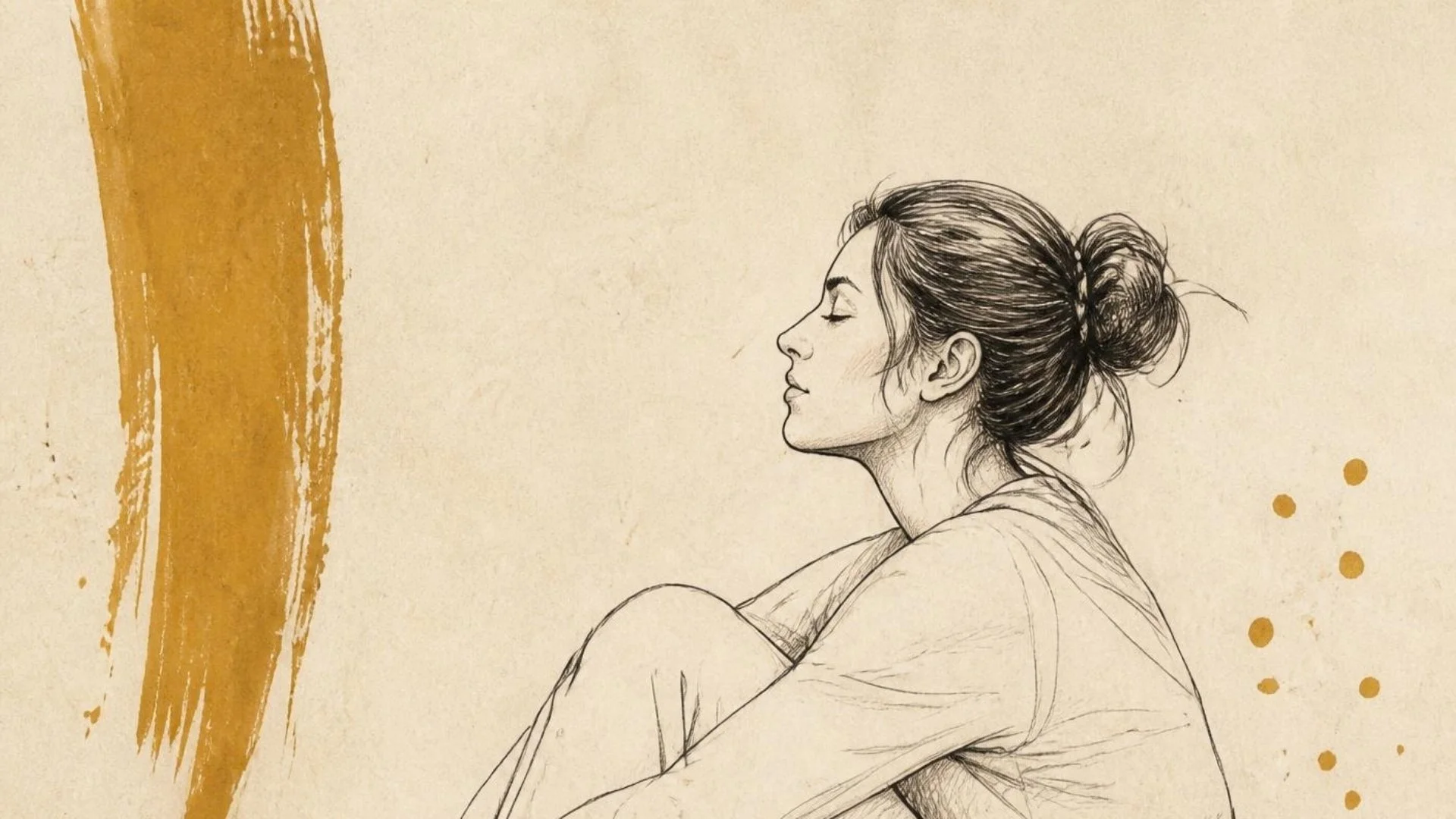
The Strange Busyness of Stopping
Doing nothing sounds simple until there is actually nothing to do.
For much of the day we move inside a structure of small demands. Messages arrive. Tasks need completing. Somebody needs an answer. We remember something while doing something else. There are things to clean, buy, decide, organise, check or prepare. Even our leisure can contain activity. We watch something, scroll, listen, read, talk, plan.
Then occasionally there is a gap.
Nothing urgently needs doing.
And within seconds we find something.
The phone is an obvious candidate. A hand reaches for it before we have consciously decided we are bored. We check something we checked ten minutes ago. We open an app without really knowing why. Perhaps we suddenly remember the washing. Or the cupboard that needs sorting. Or the message we could answer now while we have a minute.
The empty moment fills itself remarkably quickly.
This is easy to interpret as an inability to rest.
We might decide we are addicted to stimulation, incapable of being still, disconnected from ourselves, too anxious to stop.
Perhaps sometimes those descriptions contain truth.
But I wonder whether stillness is often difficult for a much simpler reason.
We are not particularly familiar with it.
The body gets good at what it experiences repeatedly. If most of our waking hours contain some form of requirement, perhaps the absence of requirement initially feels unusual.
Not dangerous.
Not wrong.
Just unfamiliar.
There is a peculiar moment when activity stops but the momentum of activity remains. We sit down, but thought continues moving. The body may still be slightly prepared for the next task. Attention remains tuned towards interruption.
Perhaps the first few moments of doing nothing are not actually still at all.
They are the transition out of doing.
That feels important because we often judge rest by what happens immediately after we stop.
We sit down and discover we are restless.
We lie in bed and thoughts become louder.
We put the phone away and suddenly remember everything.
We conclude that stopping does not work for us.
But perhaps stopping has worked perfectly.
Perhaps it has made visible what activity had been covering.
When the environment becomes quieter, we notice the noise that was already present.
That is not necessarily a problem.
Imagine walking out of a loud room. For the first few moments afterwards, your ears may seem oddly aware of the absence of sound. The quiet has a quality of its own because of what came before it.
Maybe internal stillness has transitions too.
We do not move instantly from busy into blankness.
Perhaps there is a period of deceleration.
Thoughts finish their sentences.
The body notices where it has been holding itself.
Things that could not get our attention while we were occupied appear.
And because we interpret the appearance of those things as evidence that we cannot relax, we often start doing again before we have discovered what happens next.
Phone.
Television.
Task.
Conversation.
Anything that restores familiarity.
There is no moral problem with that.
I am not particularly interested in turning stillness into a superior way of living. Doing things is wonderful. Stimulation can be enjoyable. Phones are useful. Entertainment is fun. Productivity can feel satisfying.
The question is simply whether we have choice.
Can we do nothing sometimes without immediately needing the nothing to become something?
That may be harder than it sounds.
Even practices designed around stillness can become incredibly busy. We meditate and monitor whether our mind is quiet. We lie down and scan the body. We rest and assess whether we feel rested. We breathe and pay attention to how we are breathing.
Stillness becomes an activity.
Perhaps that is partly because unstructured nothingness gives us very little to measure.
If there is no task, there is no completion.
If there is no desired state, there is no success.
If nothing is supposed to happen, how do we know whether we are doing it properly?
Maybe we don't.
That can feel strangely exposing.
So much of adult life gives us feedback. We finish things. We receive messages. We solve problems. We get paid. We tick boxes. We produce visible evidence that time has been used.
Doing nothing produces very little evidence.
An hour can pass and nothing may exist afterwards that proves what happened.
There is something almost radical about that in a culture where time is constantly being turned into output.
Even rest has become productive.
We rest to recover.
We meditate to improve focus.
We exercise for health.
We sleep so we can perform better tomorrow.
Everything needs a reason.
What would happen if sometimes nothing was simply nothing?
Not recovery.
Not regulation.
Not self-care.
Not preparation for whatever comes next.
Just a period in which we temporarily stop asking time to produce something.
I suspect that is one reason it can feel uncomfortable.
Without a purpose, we are left with experience itself.
And experience can be messy.
You might feel bored.
You might become aware that you are tired.
You might think about something you were successfully ignoring.
You might feel an urge to move.
You might discover you do not actually want to sit still at all.
Stillness does not guarantee peace.
That seems obvious when written down, but we often treat the two as though they should arrive together.
Perhaps this is why somebody can lie completely still and feel internally frantic, while another person can be walking quickly and feel deeply settled.
Stillness is a description of movement.
Settledness is something else.
Doing nothing does not necessarily produce either.
Maybe its value, if it has one, is that it removes some of the external instruction long enough for us to notice what remains.
Not so we can fix it.
Just so it becomes part of the information available to us.
There can be a moment after stopping where the body starts offering suggestions.
Move this leg.
Turn over.
Stretch.
Get up.
Stay here.
Perhaps we have become so accustomed to following schedules and tasks that these tiny spontaneous impulses are difficult to hear until there is less competing for attention.
Doing nothing may create space for movement rather than prevent it.
I like that contradiction.
Stillness can contain movement.
Rest can contain restlessness.
Quiet can contain thought.
Perhaps the problem begins when we decide that one invalidates the other.
If I am thinking, I am not resting.
If I want to move, I have failed to be still.
If I feel bored, I should be doing something useful.
There are so many rules available.
What if none are required?
Perhaps we could allow stillness to be busy at first.
Let the thoughts arrive.
Let the impulse to check the phone be an impulse without immediately turning it into an action or a battle.
Notice that you want to get up.
Maybe get up.
Maybe don't.
Nothing about this needs to become a discipline.
That matters because discipline can creep into almost anything.
We can become good at stillness.
Proud of how long we meditate.
Impressed by our ability to sit through discomfort.
And perhaps those capacities are useful in some contexts, but I am interested in something less performative.
What happens when there is no achievement available?
Can we still allow ourselves to be there?
There is something about unfamiliarity that is useful to remember.
The first time we do anything, more attention is required. A route feels longer when we do not know where we are going. A new room feels more noticeable than one we enter every day. New shoes occupy our awareness in a way old shoes do not.
Familiarity reduces the need for attention.
Perhaps stillness can become familiar too.
Not because we train ourselves into a permanent state of serenity, but because the body learns that a gap does not always need to be filled immediately.
There can be five minutes with nothing happening.
Then ten.
Perhaps one day we realise we have been sitting somewhere doing very little and have not needed to make a decision about it.
The unfamiliar has become ordinary.
And perhaps that is what rest often needs.
Not a technique.
Repetition.
Experience.
Enough moments of stopping that stopping no longer feels like an interruption.
Enough empty space that empty space stops demanding to be filled.
Enough periods in which nothing is expected that the body does not have to remain prepared for the next thing.
This does not mean everybody needs hours of stillness.
Perhaps your version is tiny.
Waiting for the kettle without picking up your phone.
Sitting in the car for a minute after arriving.
Not immediately switching something on when you enter the house.
Allowing the last few minutes before sleep to remain unoccupied.
Not as a practice.
Not as a challenge.
Simply moments where there is nothing particular to do.
And perhaps you will hate them.
That is allowed too.
We do not have to turn stillness into something virtuous.
Some people genuinely prefer more activity than others. Some bodies enjoy movement. Some minds like stimulation.
The point is not to become somebody who enjoys doing nothing.
Perhaps the question is whether the discomfort of nothing immediately becomes an instruction to escape it.
Because sometimes discomfort changes if we remain curious for another moment.
Not always.
Sometimes boredom remains boredom.
Sometimes sitting still genuinely does not contribute.
But perhaps occasionally the busyness at the beginning is simply momentum.
Like water continuing to move after something disturbed it.
We do not have to press the water flat.
Movement completes itself.
That image feels useful.
Perhaps there are moments where our own momentum can complete itself too.
The day has been moving.
The mind has been moving.
The body has been responding.
We stop.
And everything does not instantly become still simply because the activity has ended.
Why would it?
Maybe the expectation of instant stillness is stranger than the restlessness itself.
There can be a gap between doing and feeling stopped.
We might become kinder to ourselves if we allowed for it.
No immediate calm required.
No perfectly empty mind.
No proof that rest is working.
Perhaps the first part of doing nothing is simply noticing how much is still happening.
And perhaps after that something changes.
Or perhaps it does not.
Either way, we have not failed.
Stillness is not difficult because we are doing it wrong.
Sometimes it is simply unfamiliar.
And unfamiliar things often become less remarkable when we have encountered them enough times to realise that nothing terrible happens if we stay for another minute.
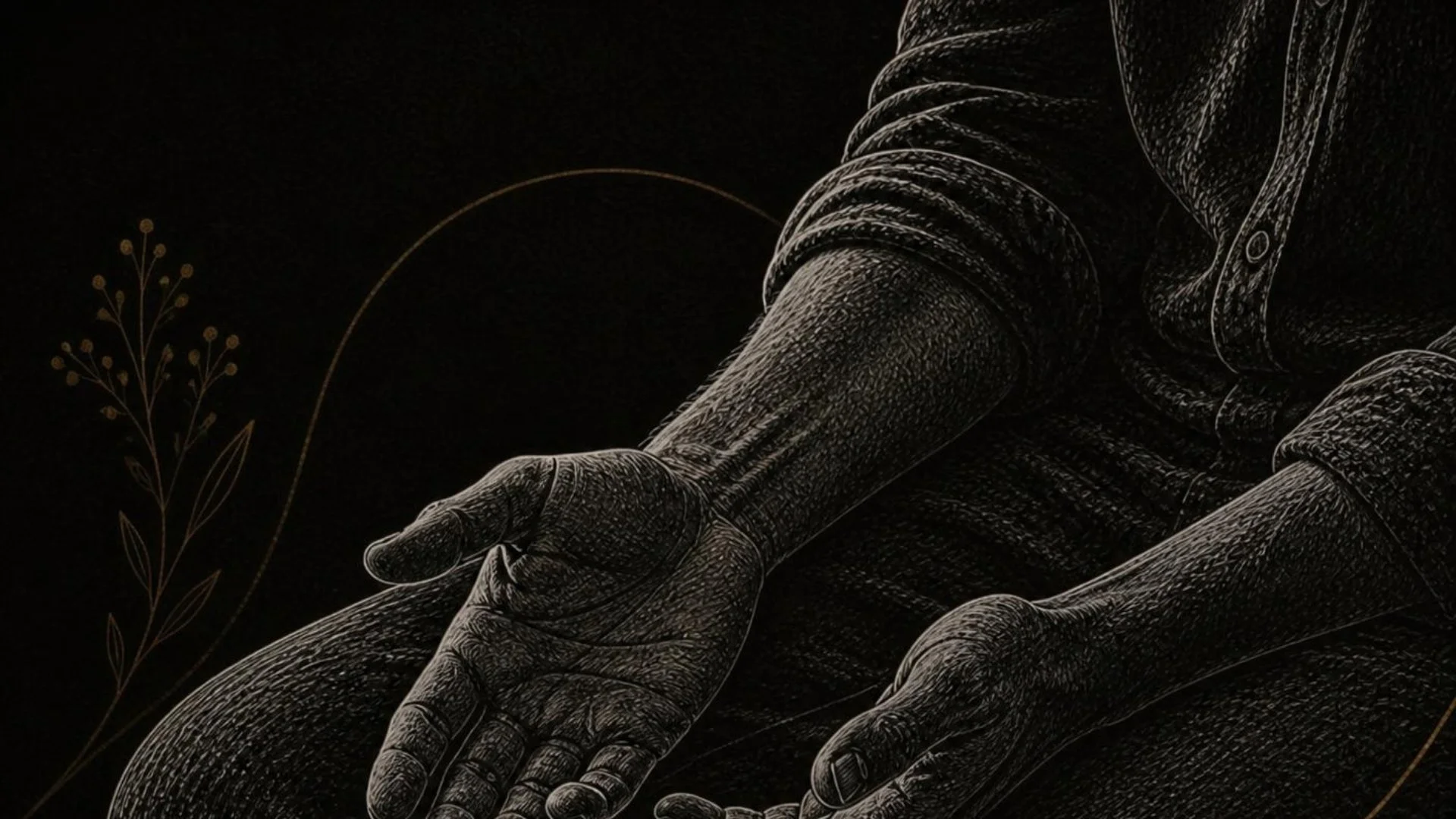
The Difference Between Carrying and Caring
There are days when everything seems heavier.
Not necessarily physically. Nothing obvious may have changed. The same room, the same body, the same responsibilities. And yet moving through the day seems to require more effort than usual. Thoughts feel weightier. Decisions that would normally take seconds become strangely complicated. The next task appears larger than it is.
Sometimes we describe this simply as feeling heavy.
It is an imprecise phrase, but perhaps that is part of why it works. We are not always talking about sadness. Not necessarily tiredness. Not necessarily stress. Just a quality of weight.
And because heaviness feels like something pulling us down, the instinct is often to push against it.
Get moving.
Do something.
Shake it off.
Go for a walk.
Sort yourself out.
Keep going and perhaps eventually the feeling will change.
Sometimes movement genuinely helps. Bodies like movement. A different environment, fresh air, completing something small, speaking to someone, eating, sleeping or changing pace can alter an experience enormously.
But I wonder whether every experience of heaviness is asking to be lifted.
Perhaps sometimes the weight itself contains information.
When we use the word carrying, we often use it metaphorically. We carry responsibility. We carry worry. We carry other people’s needs. We carry unfinished conversations, decisions, expectations and things we have promised ourselves we will deal with later.
None of these things have physical weight, and yet the experience of them can be remarkably bodily.
Shoulders tighten.
Movement feels slower.
Rest feels necessary but somehow unavailable.
We sit down and discover the mind is still carrying on.
It can be tempting to make a literal story from that. To imagine that every heavy limb represents emotional burden, every tense shoulder contains responsibility, every physical sensation is the body communicating a metaphor.
I am cautious about that.
Bodies are bodies.
Legs can feel heavy because they are tired.
Shoulders can hurt because we slept strangely.
Not every sensation is symbolic.
But perhaps there is still value in recognising that carrying is not only physical.
Attention carries things too.
We hold an astonishing number of unfinished pieces of life in awareness. Things we need to remember. People we need to reply to. Situations we are waiting to understand. Tasks that have not yet become urgent enough to do but remain present enough to occupy a little background space.
One or two of these things may barely register.
Fifty of them can create a kind of invisible load.
Perhaps heaviness sometimes appears when there is simply a lot.
Not a disaster.
Not overwhelm.
Not necessarily anything requiring a dramatic intervention.
Just a lot.
I think we can be strangely reluctant to allow that explanation.
We prefer something we can solve.
If I am tired, perhaps I need better sleep.
If I feel flat, perhaps I need motivation.
If I feel heavy, perhaps I need to move more.
The possibility that life currently contains a lot of information, decisions, relationships, responsibilities and unfinished pieces can feel too ordinary.
But ordinary things accumulate.
A friend going through something difficult.
A family member who needs attention.
A deadline.
A business decision.
Something in the house that remains unfinished.
An appointment you need to remember.
A relationship that is changing.
One of these might be manageable.
All of them arriving close together may simply require more internal space.
Not because we have made ourselves responsible for everybody else’s life.
We can care about things without carrying responsibility for solving them.
But caring still affects us.
Being aware of something still occupies some part of attention.
Perhaps we sometimes become so determined not to take things on that we forget there is a difference between responsibility and impact.
Something can affect you without belonging to you.
Someone you love can be hurting and you can know perfectly well that it is not your job to fix them while still feeling the weight of knowing.
That is not failure.
It is relationship.
Maybe this is why the question What am I carrying? can be useful if we ask it without assuming there must be something dramatic hidden underneath.
Perhaps the answer is simply: a lot of little things.
Or one big thing.
Or nothing identifiable at all.
The question does not have to produce an answer.
Sometimes it simply creates a pause between the sensation of heaviness and the immediate instruction to push through it.
That pause can matter.
Because pushing through becomes habitual very easily.
The body feels tired and we make coffee.
The mind feels full and we open another tab.
Something feels too much and we tell ourselves we only need to get through today.
Again, none of those choices is necessarily wrong. There are days when pushing through is exactly what we choose.
But perhaps choice requires us to notice that pushing is happening.
Otherwise effort becomes the default response to every form of resistance.
Heavy?
Push.
Slow?
Push.
Uncertain?
Push.
Unmotivated?
Push.
Eventually we can forget that there are other responses available.
Pausing does not always mean stopping completely.
It may mean looking at what actually requires attention rather than responding to the vague feeling that everything does.
It may mean noticing that three of the things occupying your mind cannot be acted on today.
It might mean writing something down so your attention no longer has to remember it.
It might mean saying no.
It might mean asking for help.
It might mean doing the next ordinary thing and leaving the larger question unresolved.
Perhaps heaviness sometimes comes from treating everything as equally immediate.
The body does not necessarily know which email is important, which worry is hypothetical and which conversation can wait until next week. It responds to the total environment we are creating.
Thought can hold ten futures simultaneously.
The body still has to live this moment.
Maybe there is relief in returning to scale.
What actually needs carrying now?
Not tomorrow.
Not the whole year.
Not everybody involved.
Now.
Perhaps one thing.
Perhaps nothing for the next hour.
The rest can remain real without being actively held.
I like the image of putting something down without necessarily getting rid of it.
We often assume that if we stop carrying something, we must be abandoning it. If we stop thinking about the problem, perhaps we are being irresponsible. If we rest before everything is sorted, perhaps we have become careless.
But putting something down is different from throwing it away.
You can return.
You can pick something back up when it actually requires you.
Perhaps our relationship with responsibility could contain more of that.
Carry.
Put down.
Return.
Instead, many of us carry continuously because we are afraid that if we stop holding something in awareness it will disappear, go wrong or prove we did not care enough.
That is an exhausting way to maintain connection with life.
Maybe something can matter without being held every second.
People can matter while you sleep.
Work can matter while you eat dinner.
A decision can matter while you walk the dog.
The unfinished thing can remain unfinished without requiring your body to remain braced around it.
Perhaps this is what pausing offers.
Not escape from reality.
A temporary redistribution of weight.
A reminder that attention does not have to hold the entire world simultaneously.
There is something similar in physical carrying. If you are carrying a heavy bag, putting it on the floor for a minute does not mean you are no longer responsible for getting it home.
You simply stop making your muscles prove that responsibility continuously.
Maybe there are emotional equivalents of the floor.
A notebook.
A conversation.
A boundary.
Another person who can hold part of the practical load.
A decision to revisit something tomorrow.
A moment where we acknowledge that something is difficult without requiring ourselves to immediately make it less difficult.
These things do not remove the weight.
They change our relationship with carrying it.
And perhaps sometimes that is enough.
I also wonder whether heaviness becomes more frightening when we assume it means something permanent.
A heavy day becomes I am struggling.
A slow week becomes I have lost motivation.
A period of uncertainty becomes I don't know what I'm doing anymore.
We are remarkably fast at converting temporary experiences into identity.
Maybe the heavy thing is simply heavy today.
Maybe there is no larger story.
Maybe the body is responding appropriately to the amount that is here.
That possibility feels kinder than immediately trying to diagnose ourselves out of the experience.
There will, of course, be times when persistent physical or emotional heaviness deserves more attention and appropriate professional support. Not every experience should be explained away as needing a pause. But in the ordinary movement of life, perhaps we could become less afraid of days that feel weightier than others.
Bodies change.
Capacity changes.
The amount life asks from us changes.
We are not machines with a fixed output available every morning.
Some days there is more room.
Some days there is less.
Perhaps wisdom is not forcing every day to carry the same load.
Maybe strength is not the ability to lift everything indefinitely.
Sometimes strength is recognising that something has become heavy before we drop it.
Sometimes it is deciding that today is not the day to carry all of it.
Sometimes it is allowing another person to take one end.
And sometimes it is simply sitting beside the thing for a while rather than immediately deciding that because it exists, it must be lifted.
There is no virtue in carrying something purely because we are capable of carrying it.
That is worth remembering.
Capability can become a trap.
If we are good at holding things together, people give us things to hold. If we are good at solving problems, problems find their way towards us. If we are good at continuing, we can continue long after continuing stopped being the only available choice.
Perhaps the body notices the load before the part of us that is accustomed to carrying does.
A heaviness.
A reluctance.
A slower movement.
Maybe those experiences are not always resistance to life.
Perhaps sometimes they are information about capacity.
Not an order to stop.
Not a diagnosis.
Just something useful to include.
Maybe the question is not How do I get rid of this heaviness?
Maybe it is What am I asking myself to carry right now?
And then, perhaps, another question becomes available.
Does all of it need lifting today?
Sometimes the answer will be yes.
Sometimes we choose to carry something difficult because it matters.
And sometimes, perhaps more often than we realise, the thing can simply remain where it is for a while.
Not abandoned.
Not solved.
Just not in our hands.

The Body Was Never Somewhere Else
There are periods of life where we can live almost entirely from the neck up without really noticing that it has happened. We think, plan, remember, organise, anticipate and solve. We move from one thing to the next according to whatever requires our attention, and the body comes with us because, of course, it does. It gets us out of bed. It drives the car. It carries the shopping. It sits through the meeting. It gets us where we need to go.
Eventually we might notice that we feel disconnected from it.
Perhaps something feels distant. We realise we have barely noticed hunger all day. We cannot remember the last time we moved simply because moving felt good. We are tired but cannot quite tell whether we want to sleep, sit, walk, eat or be left alone. We know we have a body, obviously, but our experience of living in it has become faint beneath everything happening in thought.
And then, because we are very good at turning things into projects, we decide we need to reconnect.
We start trying.
Perhaps we pay more attention. We begin checking how we feel. We make ourselves stop. We look for practices. We tell ourselves we need to be more embodied. We schedule things that are supposed to get us back into our bodies.
Sometimes these things are useful.
But sometimes I wonder whether trying to reconnect contains the same movement that created the distance in the first place.
More effort.
More supervision.
More instructions.
Another thing to get right.
It can become strangely easy to treat the body as a place we are supposed to visit.
We talk about getting back into it, reconnecting with it, listening to it, as though we live somewhere else and occasionally need to remember where we left it.
But the body has not gone anywhere.
It has been there throughout every thought, every plan, every worry, every hour of forgetting it.
The distance is perhaps not physical at all.
Maybe what changes is attention.
Attention becomes occupied elsewhere. The thinking mind grows loud because life is asking for a lot of thinking. There are things to remember, responsibilities to hold, uncertainties to anticipate. Perhaps there is genuinely not much room for noticing whether your left shoulder is comfortable or whether you would rather sit differently.
Bodies are remarkably accommodating that way.
They keep coming.
They do not usually stop functioning because we forgot to pay attention to them.
The heart continues. Breathing continues. Balance adjusts. Muscles respond. Digestion happens. Temperature shifts. Thousands of processes continue without requiring our awareness.
There is something quite humbling about that.
We talk about reconnecting with the body as though the body withdrew from the relationship.
Perhaps it did not.
Perhaps we were simply busy.
That changes the quality of reconnection for me.
Instead of imagining that I have to cross a great distance back to myself, perhaps I only need to notice something that has remained nearby the whole time.
That might be as simple as recognising that I am uncomfortable in the chair.
Or that I am hungry.
Or that I want to stretch my legs.
Or that I have been holding my breath while concentrating.
Nothing profound needs to happen.
The body does not require us to turn every moment of contact into insight.
This is something I think we complicate enormously.
The moment we begin paying attention to the body, we often start searching for meaning. What does the tension mean? Why am I tired? What is my body trying to tell me? Where did this response come from? Is this emotion stored somewhere?
Perhaps sometimes those questions are useful.
But they can also turn the body into another object of analysis.
We stop thinking about work and start thinking about the body instead.
We have changed the subject, but perhaps not the relationship.
Still analysing.
Still interpreting.
Still trying to understand enough to gain control.
Maybe reconnecting requires less understanding than we imagine.
Perhaps the body does not need to be understood in every moment.
It may simply need to be included.
That difference matters.
Including the body might mean noticing that the plan you made yesterday does not feel right today. It might mean recognising tiredness before you have reached the point of collapse. It might mean changing position because something is uncomfortable rather than remaining still because there is no good reason to move.
It might mean allowing appetite to be information.
Allowing a no to be information.
Allowing pleasure to be information.
Allowing discomfort to exist for a moment without immediately constructing a theory around it.
None of this is dramatic.
That is perhaps why it can be easy to overlook.
We are attracted to transformational experiences because they make change obvious. A huge release. A powerful insight. A moment in which we suddenly feel completely connected to ourselves.
Those moments can be beautiful.
But perhaps relationship is mostly built somewhere else.
In the ordinary returning.
The hundred small moments where you notice something and do not immediately override it.
The moment you realise you are tired and allow that information into the decision you are making.
The moment you feel yourself rushing and become curious about whether rushing is actually required.
The moment you notice tension without trying to force it away.
The moment you enjoy something and allow enjoyment itself to matter.
Reconnection might be far less about getting somewhere and far more about reducing the frequency with which we leave ourselves out.
That feels different.
Because if reconnection is a destination, there is another opportunity to fail.
I should be more connected.
I should notice more.
I should understand my body better.
I should have a better relationship with myself.
There is a peculiar irony in criticising ourselves for not being sufficiently connected to ourselves.
Who exactly is doing the criticising?
And who is being criticised?
We can create an internal relationship that looks remarkably like any difficult external one: one part demands improvement and another part is expected to comply.
Try harder.
Pay attention.
Relax.
Feel.
Know.
No wonder reconnection sometimes feels like work.
Perhaps the body is not asking us to become perfect listeners.
Perhaps it is not even asking us to listen all the time.
That sounds exhausting.
Imagine being required to monitor every internal shift, every breath, every sensation, every subtle change in energy throughout the day. We would have very little attention left for living.
Maybe connection does not require constant attention.
Relationships with other people do not work that way either.
We can love someone deeply without looking at them every second. We can spend a day elsewhere and still remain connected. We can become absorbed in something and return to the person later without the relationship having ceased to exist.
Perhaps the relationship with the body can be similarly spacious.
You can forget about it.
You can become absorbed in thought.
You can work hard.
You can spend an afternoon completely occupied with something outside yourself.
And then you notice the body again.
There you are.
Nothing has been ruined.
Maybe reconnection is not repairing a failure.
Maybe it is simply attention coming home.
There is tenderness in that idea because it removes some of the urgency.
We do not have to make up for the time we spent elsewhere.
The body has not been sitting there keeping score.
It has been living the experience too.
This is why I think trying harder can sometimes take us further away.
Effort narrows attention. When something becomes a task, we begin evaluating ourselves against it. Are we doing enough? Is it working? Have we achieved the desired result?
Connection becomes measurable.
But perhaps connection is more likely to emerge from interest than effort.
What is this like?
What do I notice?
Would something else feel better?
Not because there is a correct answer.
Because curiosity leaves room for response.
I think of the difference between touching someone because you have been told physical affection improves relationships and touching someone because you suddenly want to know how it feels to have your hand against theirs.
The action might look identical.
The quality is completely different.
Perhaps our attention toward the body has quality too.
We can turn inward in order to inspect ourselves.
Or we can notice because something has caught our interest.
One feels like management.
The other feels like relationship.
And maybe this is where reconnection actually begins.
Not by becoming more disciplined about embodiment.
By becoming less willing to treat the body as an inconvenience or an assignment.
The body can be present in the decision without controlling the decision.
Thought still matters.
Plans matter.
Responsibilities matter.
There will be days when what needs doing does not match what the body would ideally choose. Being connected does not mean obeying every impulse.
Perhaps it simply means the body gets a seat at the table.
Its information is included.
We notice that we are exhausted even if we still decide to finish the task. We notice that something feels uncomfortable before deciding whether we want to continue. We recognise desire without demanding that desire automatically become action.
Connection does not eliminate choice.
Perhaps it creates more of it.
Because information we have not noticed cannot participate in a choice.
If I have no idea I am tired, I cannot include tiredness in my decision.
If I have not noticed that a conversation is making my body tighten, I cannot become curious about whether I want to stay in it.
If I am not aware that something feels good, I may continue choosing according to what makes sense rather than what actually contributes.
Reconnection, then, may not be about escaping the thinking mind.
Thought is not the enemy.
We need thought.
It allows us to imagine, organise, understand and create.
Perhaps the problem only appears when thought becomes the sole source of information we consult.
The body has its own information.
Not always wiser.
Not always clearer.
Not a mystical oracle.
Just another part of what is happening.
A sensation.
A preference.
A movement.
A change in breathing.
An impulse toward or away.
Sometimes we know what it means.
Sometimes we do not.
Maybe we do not need to.
Connection can exist without complete understanding.
We can notice without interpreting.
We can include without obeying.
We can become curious without turning the body into another problem to solve.
And perhaps, over time, the distance begins to feel smaller.
Not because we successfully forced ourselves back into our bodies.
Because we stopped requiring reconnection to be another achievement.
The body was never somewhere else.
It was quietly waiting beneath all the thinking, planning, remembering and worrying.
Not asking for perfection.
Perhaps not asking for very much at all.
Only to be included again when we remember.

There Is No Correct Way to Feel Settled
There is a strange thing that happens when we begin talking about feeling settled. Very quickly, an image appears. A slow breath. Relaxed shoulders. A quiet mind. Perhaps someone sitting peacefully with their eyes closed, looking as though nothing in the world is particularly urgent. We have become so accustomed to associating settledness with stillness and calm that it can be easy to assume we would recognise it immediately if it arrived.
But I am not sure settled always looks like that.
For one person, feeling settled might mean their breathing becomes slower without them deliberately changing it. For somebody else, it might be the moment they realise they have stopped clenching their jaw. Another person might become more talkative. Someone might want to move. Someone might suddenly feel tired. Someone else might discover that their thoughts are still busy, but they are no longer bothered by the fact that they are busy. The external appearance can be completely different while something underneath has shifted.
Perhaps this is because settled is not really a posture.
It is not a particular breathing pattern. It is not the absence of thought. It is not necessarily relaxation, silence or stillness. Those things can accompany it, but perhaps they are not what defines it.
I think we sometimes make life harder for ourselves by turning internal states into pictures of what they are supposed to look like. If calm looks a particular way, we start comparing our experience with the picture. If being grounded is supposed to feel solid, we notice every moment we feel uncertain. If being regulated is supposed to mean never becoming reactive, every reaction becomes evidence that something has gone wrong.
Settledness can become another standard we have to meet.
And there is something slightly contradictory about trying very hard to become settled.
The effort itself contains a demand. I need to be somewhere other than where I am now.
Perhaps that is why some of the moments in which we feel most settled are the ones we barely notice until afterwards. We become absorbed in something. We sit with someone without needing the conversation to go anywhere. We drive a familiar road and realise we have not been thinking about ourselves for several minutes. We finish something that has been occupying our attention and discover there is no immediate next thing asking for us.
There may not be a dramatic drop into peace.
There might simply be less demand.
That difference interests me.
Because perhaps settledness is not defined by what is happening inside us so much as by the relationship we have with what is happening.
A thought can be present without requiring an answer. A sensation can exist without becoming a problem. An unfinished task can remain unfinished without following us around the room. Someone else can be disappointed without us immediately rushing to change their experience. The body can be tired without tiredness becoming something to overcome.
Nothing necessarily disappears.
It just stops requiring quite so much.
Maybe that is one reason settled feels different for everyone. The things that usually ask the most of us are different. One person spends their day anticipating everybody else’s needs. Another lives almost entirely inside thought. Somebody else is constantly moving, organising, deciding. Another has become so accustomed to watching their body for signs of something being wrong that sensation itself has become demanding.
For each of them, the reduction in demand may look different.
The person who anticipates might suddenly realise they have stopped monitoring the room. The person who thinks constantly may still have thoughts, but no longer feel compelled to follow every one. The person who is always moving may sit for five minutes without immediately finding a reason to stand up again. The person monitoring their body may notice a sensation and allow it to remain unnamed.
None of these experiences look particularly impressive.
That might be part of their value.
We are often looking for change to make itself obvious. We want to know that something has worked. We want a before and after. We want the measurable difference between the state we arrived in and the one we leave with. But perhaps the body’s changes are often quieter than the story we want to tell about them.
Sometimes the evidence is simply that we forgot to keep checking.
There is a particular quality to those moments when nothing seems to need our attention. Not because there is literally nothing happening. The world has not stopped. There are probably still unanswered messages, washing somewhere, work that needs doing, people with opinions, decisions waiting for another day. But for a moment, none of it is reaching into the body and asking to be handled now.
That feels close to settledness to me.
Not a completed life.
Not a perfectly calm body.
A temporary absence of demand.
And perhaps the word temporary matters.
We often imagine that the goal is to become settled, as though once we achieve it we should remain there. But bodies are responsive. Life changes. Something happens and our attention moves. We become excited, concerned, curious, angry, interested, afraid. The body prepares for movement. Thoughts accelerate. Energy changes.
That is not necessarily a loss of progress.
Maybe settled is something we move in and out of.
Something we return to.
The idea of returning feels very different from the idea of maintaining. Maintaining creates another responsibility. If I finally feel good, I need to keep it. If my body feels settled today, I need to avoid anything that might disturb it. If I have found calm, perhaps the next task is making sure I do not lose it.
Before long, we are guarding the state we worked so hard to achieve.
Returning allows movement.
We can become unsettled.
We can be affected.
We can have difficult days.
We can be busy, reactive, distracted, excited or confused.
And still there can be another moment later where something softens, shifts or becomes less demanding.
Perhaps this is why I am interested in the word settled rather than calm. Calm can sound like an absence of activation. Settled feels broader. You can be settled and still laugh loudly. You can feel settled while walking quickly somewhere you genuinely want to go. You can be settled in a difficult conversation because, although the conversation matters, you are not abandoning yourself inside it.
You might even feel settled while uncertain.
That seems important.
Because uncertainty is so often treated as something that prevents us from being okay. We imagine we will settle when we know what is happening, when the decision has been made, when the answer arrives, when the money is sorted, when the relationship is clear, when the body makes sense again.
But perhaps settledness does not require certainty.
Perhaps it requires enough space for uncertainty to exist without becoming the whole environment.
I can not know and still sit here.
I can be waiting and still eat dinner.
I can care deeply about what happens next without spending every moment trying to arrive there before it happens.
There is a kind of internal flexibility in that. Not detachment. Not pretending we do not care. Simply the possibility that one unanswered thing does not have to occupy every part of us.
And perhaps this is where the body gives us useful information.
We may think we are settled because the circumstances look fine, while the body remains busy. Or we may think we are unsettled because thoughts are moving, while something deeper has actually become easier. The external picture can deceive us in both directions.
A slower breath can be information.
So can a sigh.
So can noticing that your hands have unclenched.
So can realising you have stopped rehearsing the conversation.
So can suddenly wanting food.
So can feeling sleepy.
So can finding something funny again.
Maybe settledness sometimes appears as ordinary life returning.
Not a special state.
Not an achievement.
Just more room for whatever is already here.
I also wonder how much settledness depends on not being required to perform it. There is something very different about walking into a space where somebody expects you to relax and walking into a space where nothing particular is expected of you.
The first can create another job. Am I relaxing? Has this worked? Do I look comfortable? Should I be feeling something?
The second leaves more possibility.
You might relax.
You might not.
You might feel restless first.
You might realise you are exhausted.
You might notice something you had not had enough quiet to notice before.
Perhaps the body can find its own version of settled more easily when we stop dictating what it should look like.
That feels relevant far beyond organised spaces or practices.
How often do we decide what being okay should look like before we have even asked what is actually happening?
We assume we should be less emotional, less affected, less tired, more motivated, more organised. We decide that the absence of those qualities means we have not arrived yet.
But what if the body has a different measure?
Perhaps being settled today looks like crying without fighting the crying. Perhaps tomorrow it looks like getting up and doing something. Perhaps next week it looks like realising you do not want to do the thing you thought you wanted. Perhaps one evening it is simply sitting somewhere and noticing that no part of you is currently asking what comes next.
There may not be a single settled state waiting for us.
There may only be moments in which the relationship between ourselves and our experience becomes a little less effortful.
And maybe that is enough.
Perhaps settled is not where we finally arrive when we have sorted ourselves out.
Perhaps it is something much more ordinary.
A breath that changes.
A jaw that softens.
A thought that passes without becoming a project.
A few minutes in which nothing requires an immediate response.
And perhaps we will leave it again.
Life will happen. Attention will move. Something will matter.
That does not mean the settledness was lost.
It means we are alive.
Perhaps feeling settled is less about learning how to stay somewhere forever and more about becoming familiar enough with the experience that we recognise when it returns.
Not there, finally.
More like:
Oh. Here again.

Listening Before We Change Anything
What do you notice about your breath before trying to change it? A reflection on listening, curiosity and allowing what you notice to remain information.
Most of the time, breathing happens without us paying any attention to it. We do not have to remember to inhale. We do not have to schedule the next exhale. The body carries on quietly, adjusting the breath from moment to moment while our attention is somewhere else entirely.
And then occasionally we notice it.
Perhaps you realise you have been holding your breath while reading an email. Perhaps a sigh comes out of nowhere. Perhaps you notice that your breathing has become shallow while you are trying to get something finished, or that you have taken one enormous breath the moment somebody leaves the room. Sometimes the change is so small that you barely register it. Other times it feels as though the body has been waiting for you to notice what it has been doing all along.
The breath is interesting because it sits somewhere between automatic and voluntary. You can deliberately change it, but you do not have to control it for it to continue. You can slow it down, speed it up, hold it, deepen it, sigh, hum, speak, laugh, cry. And the moment you stop managing it, the body takes over again.
Perhaps that is part of why we are so tempted to use the breath as a tool.
When we feel unsettled, we are often told to breathe. Take a deep breath. Slow it down. Breathe into your belly. Count the inhale. Lengthen the exhale. There are countless breathing practices, and some of them can be genuinely useful. A deliberate change in breathing can alter what we experience. It can give the body different information. It can create a pause.
But I wonder what happens when we become so interested in changing the breath that we forget to listen to it.
Before trying to make your breathing deeper, what if the shallow breath is worth noticing?
Before correcting the rhythm, what if there is information in the rhythm that is already there?
A breath can change long before we consciously know why. The body encounters something, responds, and perhaps only afterwards does the thinking mind catch up. A conversation becomes uncomfortable and breathing becomes smaller. Something anticipated finally happens and a breath releases. You walk into a familiar place and your chest changes before you have formed a thought about being there.
The breath is always responding.
Not necessarily telling us a secret truth. Not necessarily offering a coded message that needs to be decoded. But responding nonetheless.
That distinction matters because I do not think every held breath needs an explanation. It is very easy to turn noticing into interpretation. We feel something and immediately start asking what it means. Why am I breathing like this? What am I anxious about? What is my body trying to tell me? What does this sensation connect to?
Sometimes there may be something useful in those questions.
And sometimes a held breath is simply a held breath.
The body is doing something. That may be enough information for now.
I find that possibility quite freeing because it allows us to notice without immediately creating a problem. If you suddenly realise you have hardly been breathing while concentrating, you do not necessarily need to decide that you are stressed, dysregulated or doing something wrong. You can simply notice that the breath became small while your attention was elsewhere.
Maybe the next breath changes on its own because you noticed.
Maybe it does not.
Either way, something has become visible that was already happening.
There is a huge difference between listening to the breath and monitoring it.
Monitoring has an outcome attached. Is it deep enough? Slow enough? Calm enough? Am I doing this correctly? Has my breathing improved yet?
Listening is quieter.
What is it doing?
That is a very different question.
And perhaps it is one we rarely ask because breath has become so closely associated with regulation that we automatically assume it should be changed whenever it looks anything other than slow and steady.
But breathing is supposed to change.
If you run upstairs, your breathing changes. If you laugh, it changes. If you cry, it changes. If you speak, sing, concentrate, sleep, exercise, become surprised or feel excited, it changes. The breath is not designed to remain perfectly even throughout the day.
A responsive breath is not necessarily a problematic breath.
That feels worth remembering.
We sometimes talk about calm breathing as though calm were the body’s ideal setting and everything else represented a departure from health. But bodies are dynamic. They respond to what is happening around them and within them. A faster breath may be exactly appropriate for the moment. A deep sigh may be part of a transition. A pause may simply be what happened.
Perhaps the question is not, How do I make my breath behave?
Perhaps it is, What is my breath already doing in response to this moment?
There is something intimate about noticing that because the breath can reveal the effort we do not realise we are making.
You may discover that you hold your breath when you are waiting for an answer. Or when somebody is speaking and you are preparing your response. Or while you are concentrating on getting something right. You may notice that your breathing becomes smaller around a particular person, or fuller when you step outside, or completely different when you finally sit down after a long day.
None of these observations need to become conclusions.
They are simply pieces of information.
And sometimes the information is surprising.
You can believe you are fine and then notice the breath you take when a difficult conversation is over.
You can think you were relaxed and suddenly realise your whole chest changes when you get home.
You can tell yourself something does not bother you and notice you have stopped breathing while you wait for it to happen.
Again, that does not necessarily mean the body knows something the mind does not. I am cautious about giving the body that kind of mystical authority. The body can respond to expectation, memory, habit, physical effort, temperature, posture and countless other things. But perhaps it does mean that thought is not the only source of information we have.
Sometimes what we notice physically adds another part of the picture.
Not the answer.
Just another part.
That is what interests me about the breath.
It is happening close enough to thought that we can influence it, and far enough outside thought that it can continue without us. It belongs to both the deliberate and the automatic. We can intervene, but we are not in charge of every breath.
There is something reassuring about that.
The body keeps breathing even while we are busy thinking about everything else.
It adjusts itself while we sleep.
It responds while we speak.
It continues through moments when we have no idea what we are doing.
We spend enormous amounts of our lives being carried by processes we do not consciously manage.
Breathing is one of the most obvious examples, yet perhaps one of the easiest to overlook.
And maybe noticing the breath is less about learning how to control one more thing and more about recognising how much is already happening without our control.
That can be uncomfortable if we are used to managing ourselves carefully.
There is a strange relationship between breath and control. Because we can control breathing, it can become something we reach for when we want to control how we feel. If the body is agitated, perhaps changing the breath will calm it. If the mind is busy, perhaps breathing differently will quieten it.
Sometimes it does.
But I think it is worth noticing the subtle message that can appear underneath that approach: this breath is wrong, this state is wrong, and I need to change both.
The breath becomes another route to a preferred outcome.
What if, occasionally, we did not ask it to take us anywhere?
What if we noticed one breath without trying to improve the next one?
Perhaps it is shallow.
Perhaps it catches somewhere.
Perhaps the exhale feels longer than the inhale.
Perhaps there is a pause.
Perhaps there is a sigh.
Perhaps nothing about it is interesting at all.
Can that simply be what is happening?
There is a softness in allowing the breath to exist without immediately managing it.
Not because deliberate breathing is bad. It is not. But because choice feels different from correction.
You might notice the breath as it is and then decide that taking a deeper breath feels good.
That is different from noticing the breath and deciding it needs fixing.
One begins with curiosity.
The other begins with a judgement.
That distinction runs through so much of how we relate to the body.
We notice and correct.
Notice and interpret.
Notice and intervene.
It can be surprisingly unfamiliar to notice and do nothing.
Yet perhaps doing nothing for a moment allows us to hear something we otherwise miss.
A sigh is a beautiful example.
Sighing is often treated as though it means something socially. Someone sighs and we assume they are annoyed, bored or exasperated. We ask what is wrong. But bodies sigh for all sorts of reasons. Sometimes the sigh arrives at the end of an effort. Sometimes it appears as posture changes. Sometimes it simply seems to be part of the respiratory system recalibrating itself.
Whatever its cause, there is often something unmistakable about the feeling of a sigh that was not deliberately produced.
The body does it before you decide to.
And then you notice the space afterwards.
That can feel very different from being instructed to take a deep breath.
One is an action.
The other is an event.
Perhaps this is part of what the breath can show us: the body is not waiting passively for our instructions. It is participating in our experience all the time.
It is adjusting.
Responding.
Experimenting.
Returning.
Sometimes the body changes first and we notice afterwards.
Sometimes we deliberately change something and the body responds.
There is movement in both directions.
This is why I hesitate when people talk about breathing as though there is one correct way to do it. A body asleep needs something different from a body running. A body laughing needs something different from a body speaking. A body in grief may breathe very differently from a body lying in the sun.
The point cannot be to maintain one ideal breath regardless of the circumstances.
Perhaps the point, if there needs to be one at all, is flexibility.
The ability for the breath to change.
The possibility of holding and then releasing.
Of becoming faster and then slower.
Of adapting to what is happening instead of being permanently fixed in one pattern.
And perhaps our relationship with the breath can have that flexibility too.
Sometimes we intervene.
Sometimes we listen.
Sometimes we forget about breathing altogether and allow the body to get on with it.
There is no prize for paying attention to every breath.
In fact, I think that would become exhausting very quickly.
The invitation is much smaller.
Every now and again, the breath may catch your attention.
Maybe while waiting at a red light.
Maybe in the middle of a conversation.
Maybe when you lie down.
Maybe when you finally finish something you have been concentrating on for hours.
And rather than immediately changing it, perhaps there can be a moment of simple recognition.
Oh. That’s what my breathing is doing.
Nothing more required.
That moment of noticing may already alter the breath. Bodies are funny like that. Attention itself can change what we are observing. But the aim does not have to be change.
It can simply be contact.
I think there is something valuable in that because so many of us spend a great deal of time living slightly ahead of ourselves. Thinking about what needs to happen next. Rehearsing. Predicting. Preparing. Solving.
The breath cannot happen tomorrow.
It cannot happen yesterday.
Whatever stories the mind is travelling through, breathing is occurring now.
Again, I do not think that means we should force ourselves into the present. There is no virtue in becoming annoyed with yourself because your mind wandered away while you were supposed to be noticing your breathing.
The mind wandered.
The breath kept going.
That in itself is rather lovely.
Perhaps we do not always need to use the breath to bring ourselves back.
Perhaps sometimes we simply discover that it never left.
Even while attention travelled somewhere else, the body remained here breathing.
There is support in that which I think is easy to miss.
Not dramatic support.
Not reassurance that everything will be okay.
Simply the fact that the body continues.
A breath arrives.
Then another.
Not because we have earned it or remembered to ask.
It just happens.
And yet the breath is not always soft or comfortable. There are times when breathing itself can feel difficult, restricted or unsettling. There are physical reasons for this that deserve proper attention, and noticing the breath should never become a reason to dismiss symptoms that need medical care.
But in the ordinary fluctuations of everyday breathing, perhaps there is value in allowing variety.
Not every shallow breath means danger.
Not every deep breath means calm.
Not every sigh means relief.
Not every held breath has a psychological explanation.
The breath may be telling a story, but that does not mean we know the plot.
I think that is the piece I like most.
We can listen without deciding.
The breath can become information without becoming a diagnosis.
We can notice that something changed without rushing to name why.
Maybe over time patterns become obvious. Perhaps we notice that certain situations consistently change our breathing. Perhaps we discover that particular spaces invite a fuller breath without any effort. Perhaps someone’s presence seems to alter something. Perhaps the body exhales differently when there is no longer anything expected from it.
Those patterns may be useful.
Not because they tell us exactly what to do, but because they give us more of ourselves to include in the conversation.
Thought says one thing.
The breath does another.
Neither necessarily wins.
We simply know a little more than we did before.
And perhaps that is enough.
We do not need to turn the breath into another project.
We do not need to breathe perfectly.
We do not need every inhale to be deep, every exhale long, every moment calm.
We might simply become a little more interested when the breath makes itself noticeable.
The breath that disappears while you concentrate.
The sigh you did not know you were waiting to take.
The exhale when somebody finally says the thing you needed to hear.
The sudden fullness of breathing when you step outside.
The pause.
The rhythm.
The change.
Not instructions.
Not conclusions.
Information.
Perhaps the question was never whether you were breathing properly.
Perhaps the more interesting question is what your breath has been responding to all along.
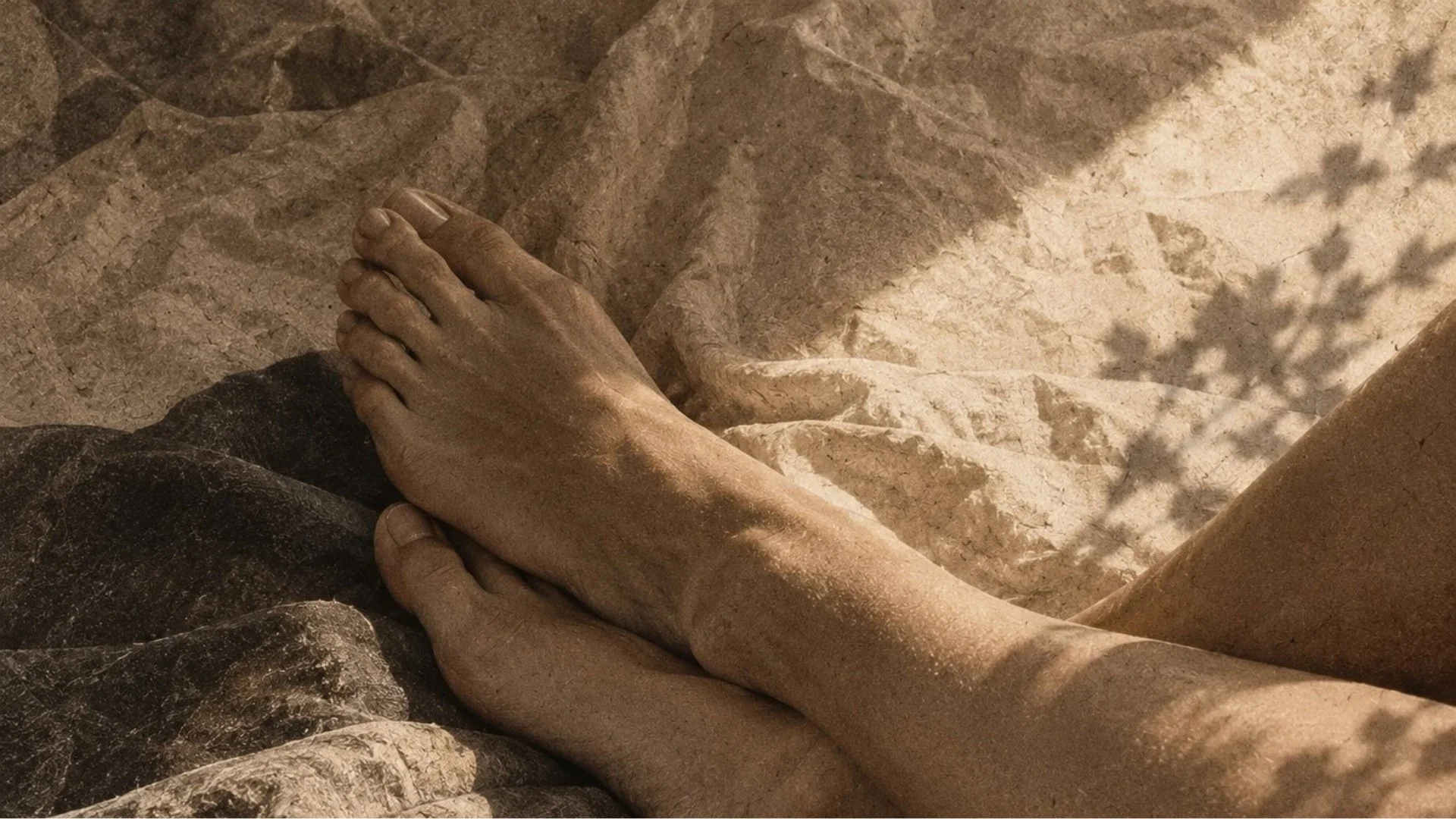
What If Release Can’t Be Forced?
“Just let it go” sounds simple, but holding on is not always a conscious choice. Perhaps our role is not to force release, but to create the conditions where holding is no longer required.
We hear it all the time: just let it go. It is offered as advice, encouragement, sometimes even as a kind of wisdom. Let go of the past. Let go of the anger. Let go of the tension. Let go of what no longer serves you. There is something appealing about the phrase because it suggests freedom, lightness, movement. It sounds simple. Clean. Almost obvious.
But bodies are not especially interested in what sounds obvious.
You can decide that you are finished with something and still feel it in your chest. You can understand why something happened and still notice your stomach tighten when you think about it. You can know that a situation is over and still find yourself responding as though some part of it remains unfinished. You can tell yourself that you no longer need to hold on, and yet the holding continues.
Perhaps because holding on is not always a conscious choice.
We often talk about letting go as though we are gripping something deliberately. As though our fingers are wrapped around an old experience and all we need to do is open our hand. Sometimes that may be true. Sometimes we are actively rehearsing, revisiting or reinforcing something long after it has passed. But sometimes what looks like holding on is simply the body continuing to organise itself around information it has not yet updated.
A muscle remains braced because bracing became useful. A breath stays shallow because some part of the body learned that being ready mattered more than breathing fully. Attention keeps returning to the same place because there was once something important to notice there. The body does not always maintain these patterns because it is unwilling to move on. Sometimes it maintains them because, at some point, they made sense.
That distinction matters.
If we assume the body is deliberately clinging to something, the obvious response is to persuade it to release. We stretch. Breathe. shake. Think differently. Forgive. Reframe. Understand. Push ourselves towards acceptance. None of those things are inherently wrong. They can all be useful. But there is a subtle difference between creating more possibility and demanding that the body demonstrate that it has moved on.
The second one can become another form of pressure.
You notice tension and think, I need to let this go. You notice sadness and think, Why am I still carrying this? You notice that an old situation still affects you and decide that you should be over it by now. The original experience is still there, and now another layer appears beside it: impatience with yourself for not having released it properly.
We can become remarkably harsh with ourselves in the name of healing.
Perhaps letting go is one of those ideas that becomes less useful the more tightly we try to do it.
There are things the body releases naturally all day long without our involvement. A breath leaves. A muscle contracts and then softens. Attention moves. Hunger changes. Sleep comes and goes. We are not required to supervise every one of these processes. There is a rhythm of holding and releasing happening constantly, and most of the time we barely notice it.
That makes me wonder whether release is sometimes less something we do and more something that happens when the conditions change.
Think about the difference between being told to relax and noticing yourself relaxing. They are not quite the same experience. Being told to relax can make you suddenly aware of every part of you that isn’t. Your shoulders become conspicuous. Your jaw appears to have opinions. You begin monitoring your breathing. You try to produce the correct version of relaxed and, rather ironically, end up working quite hard.
But there are other moments when you soften without deciding to. You arrive somewhere familiar. Someone you trust walks into the room. A difficult task is finished. A door closes behind you and you realise you are alone. You get into bed after a long day and notice your whole body sink into the mattress. No instruction was required. Something changed in the environment, and the body responded.
Maybe release works like that more often than we realise.
If holding has been useful, then perhaps the interesting question is not How do I make myself stop holding? but What would allow the holding to become unnecessary?
That question is gentler, but it is also more precise.
Because the body may not need convincing. It may need evidence.
It may need time.
It may need a different experience repeated often enough to become believable.
It may need enough support that it does not have to work so hard.
It may need a boundary that is actually respected rather than merely understood.
It may need more choice.
It may need less demand.
It may need permission to move instead of being asked to remain still.
It may need the thing that happened to actually be over.
And sometimes it may simply need us to stop staring at the holding and waiting for it to disappear.
There is a strange paradox in that. The more closely we monitor whether something has gone, the more attention we give it. We keep checking the shoulder to see whether it has dropped. We keep testing whether the memory still hurts. We keep asking whether we feel different yet. The body becomes the site of an ongoing assessment.
Has it released?
Is it better?
Am I done with this?
What if that constant checking is another kind of holding?
Not because we are doing anything wrong, but because attention itself can become part of the pattern. The thing we are desperate to be rid of remains centre stage.
Perhaps there is something freeing in allowing an experience to be unfinished for a while.
That does not mean resignation. It does not mean deciding that nothing will ever change. It simply means removing the deadline.
There is a great deal of cultural enthusiasm for completion. Closure. Moving on. Getting over it. Becoming the version of yourself who is no longer affected. We like neat endings because they reassure us that difficult experiences have an expiry date. We want to know that if we do the right work for long enough, eventually the old thing will disappear completely.
But bodies do not always organise themselves into neat chapters.
Sometimes something changes dramatically. Sometimes there is a clear before and after. And sometimes an old response simply becomes less frequent, less intense, less convincing. You notice months later that a situation which used to consume an entire day now takes up ten minutes. You realise you have stopped rehearsing a conversation you once replayed constantly. A place that used to make you brace becomes ordinary. You hear a particular name and nothing much happens.
There may have been no moment of letting go.
It just stopped requiring so much from you.
I think that kind of change is easy to miss because it does not announce itself.
We are often looking for release to feel like something dramatic leaving the body. A huge exhale. Tears. A shake. A sense of lightness. And sometimes that happens. But perhaps release can also look like forgetting to be bothered. Realising you have not thought about the thing all week. Choosing differently without having to argue with yourself first. Noticing that the response still exists, but no longer feels like an instruction.
That last one matters to me.
Because perhaps letting go does not always mean erasing a response.
Sometimes it means having more choice around it.
A sensation appears, and you no longer have to organise your whole life around making it disappear. A memory arrives, and it is simply a memory rather than a command to revisit the past. Tension shows up in the body and you notice it without immediately deciding something is wrong. The old pattern may still knock on the door, but it is no longer the only voice in the room.
That is a different kind of freedom.
It is less glamorous than complete release, but perhaps more realistic.
There is also something important about recognising that holding can be intelligent.
A body that braces is not necessarily malfunctioning. A person who remains cautious after being hurt is not necessarily refusing to heal. Someone who needs more time is not failing to move on. We are very quick to label persistence as resistance, especially when we have decided that the healthier state should look different.
But perhaps a response remains because it still has a job.
That job may no longer be required, but the body may not know that yet.
If someone has spent years needing to anticipate other people’s moods, it may take more than one safe relationship for that vigilance to disappear. If rest has repeatedly been interrupted, the body may not instantly trust an empty afternoon. If saying no once caused trouble, the ability to say no now does not automatically make it easy. The current situation may be different, while the body is still learning the difference.
Again, this does not mean we have to endlessly explain everything through the past. Not every sensation needs a childhood attached to it. Not every tight muscle is a message. Not every reaction contains a hidden story waiting to be decoded. Sometimes the body is tired. Sometimes it is cold. Sometimes we sat awkwardly for too long.
Curiosity does not require mythology.
But it can be useful to recognise that forcing release makes very little sense if we have not first considered why holding might still be happening.
If your hand is gripping something because you believe you will fall without it, telling the hand to relax misses the point.
The grip changes when support becomes available.
And perhaps this is where the idea of creating conditions becomes much more interesting than trying to produce an outcome.
What are the conditions in which the body no longer has to hold so much?
Maybe there is more time. Maybe there is somewhere to put your weight. Maybe there is another person present who is not asking anything from you. Maybe there is room to change position. Maybe you know where the door is. Maybe you know you can leave. Maybe there is no expectation that the experience must become something meaningful.
Sometimes the condition is simply not being hurried.
There is something profoundly different about a body that is allowed to arrive in its own time.
We can see this even in small things. If you are trying to fall asleep, the instruction go to sleep now is almost comically unhelpful. Sleep comes when a collection of conditions makes sleep possible. Darkness, enough tiredness, a degree of comfort, a reduction in demand. You can encourage those conditions, but you cannot force the exact moment consciousness disappears.
Perhaps some forms of release are like that.
You can make room for them.
You can notice what makes holding more necessary and what makes it less necessary.
You can remove a little pressure.
You can stop insisting.
And then something may happen that could never quite happen while you were trying to make it happen.
There is relief in that for me because it takes release out of the category of personal achievement.
You do not have to become good at letting go.
You do not need to prove your progress by no longer being affected.
You do not have to force your body into softness in order to demonstrate that you are safe, healed, regulated or evolved.
Perhaps the body will release when it has enough information that holding is no longer the best available option.
And perhaps some things are released in stages.
A little today.
Nothing tomorrow.
More next month.
Something appears again when life becomes difficult and disappears when there is more space.
That does not necessarily mean you have gone backwards.
Bodies are responsive. That is part of what they are for.
A familiar protective pattern appearing under pressure does not erase every experience that came before it. It may simply mean that, in this moment, the body has reached for something familiar.
We can notice that without making it a failure.
Maybe this is why I am cautious about the phrase let go of what no longer serves you. It assumes we already know what is no longer serving us and that the body has somehow failed to notice. But what if the response still believes it is serving something important? What if it has simply not encountered enough evidence to retire yet?
Perhaps instead of declaring something useless, we could become interested in what it has been trying to do.
Not to keep it forever.
Not to justify every response.
Simply to meet it without immediately turning it into an enemy.
There is a different quality to saying, You don’t need to be here, and saying, I notice you’re still here.
The second leaves room for information.
And perhaps that is enough.
Because the body is constantly updating. Even when nothing dramatic seems to be happening, it is taking in experience. This person responded differently. That boundary held. I rested and nothing collapsed. I spoke and was listened to. I felt the sensation and did not have to escape it. I got through the uncertainty. I did not know what would happen and survived not knowing.
These experiences accumulate.
One day the body may respond differently before we have even noticed that anything has changed.
The jaw does not tighten.
The shoulders remain down.
The breath keeps moving.
You do not rehearse what you are going to say.
You do not need to check.
You simply do something else.
Perhaps that is letting go.
Not a command.
Not a dramatic act of release.
Not throwing away a part of yourself that should have disappeared sooner.
Just a gradual reduction in the need to hold.
And if that is true, perhaps our role is not to force the body’s hand open.
Perhaps it is to notice what the hand believes it is holding onto, what it fears would happen if it stopped, and what kind of support would make gripping less necessary.
Then we create a little more of that.
A little more choice.
A little more time.
A little more support.
A little less demand.
And we leave room for the body to do what bodies have always done.
Respond to what is actually here.
Maybe you do not have to let go.
Maybe, when holding is no longer required, letting go is what happens next.
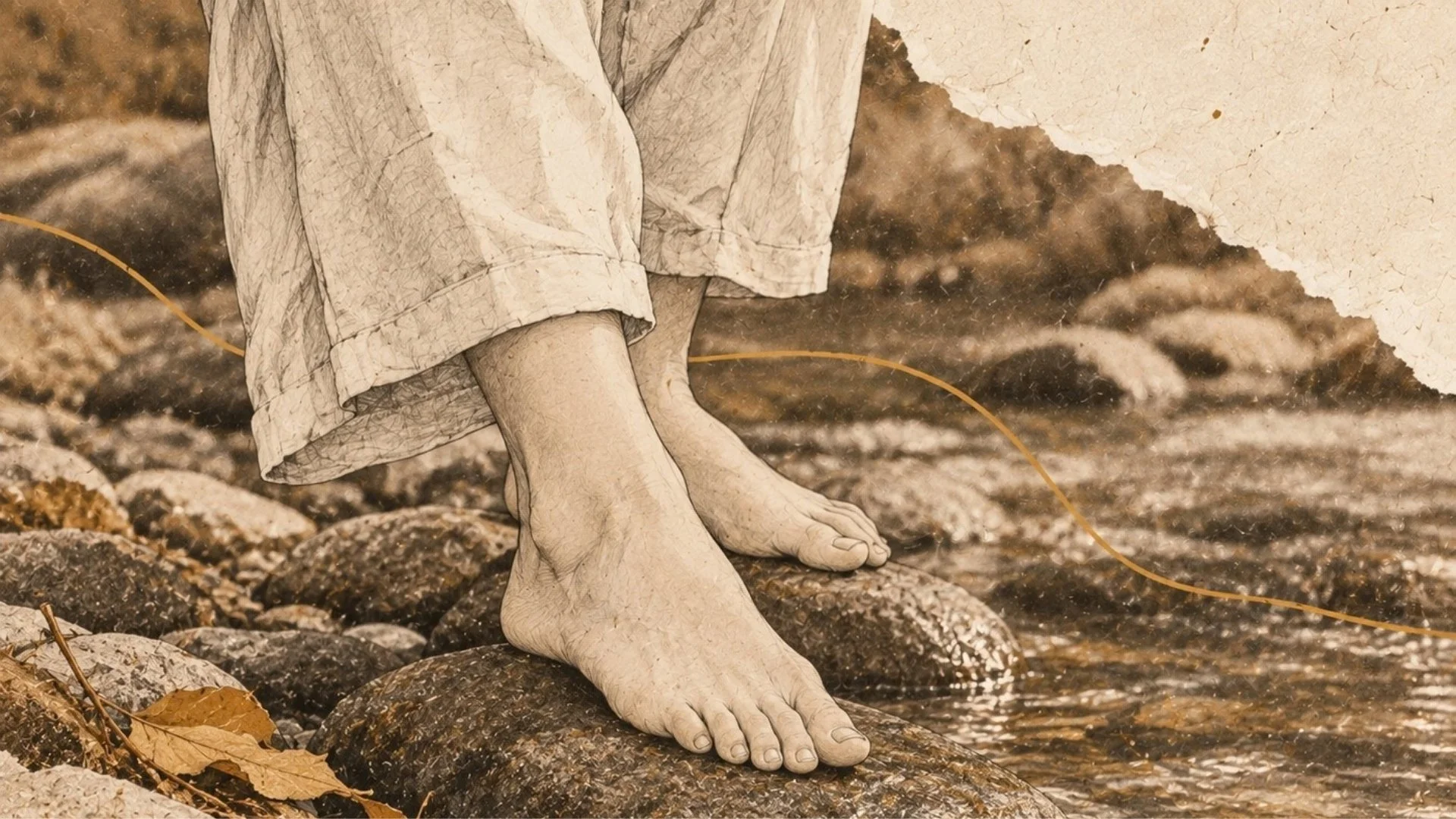
What Is Already Holding You?
We often talk about grounding as something we have to do. But what if it is less about creating a particular state and more about noticing the support that is already there beneath us?
There are certain words we use so often that eventually they begin to sound like instructions. Grounding is one of them. We talk about needing to ground ourselves, becoming more grounded, finding something that will bring us back into the body, as though groundedness is a state we have wandered away from and now need to work our way back towards. There are practices for it, techniques for it, objects for it, breaths for it, and sometimes those things are useful. Sometimes deliberately noticing what is around us does change something. Sometimes paying attention to the body can interrupt the momentum of a racing mind. But I wonder if we have made grounding more complicated than it needs to be.
Because the ground has always been there.
Even in the moments when you feel scattered, overwhelmed, distracted or miles away from yourself, something is already supporting your weight. The floor beneath your feet. The chair underneath you. The bed holding your body while you sleep. Gravity doing what gravity does without asking you to participate in it. You do not have to remember how to be held by the ground. It is happening before you notice.
That interests me because so much of what we do with the body begins from the assumption that something is missing. We need to create calm, find balance, become centred, get back into our bodies, regulate, settle, ground. The language itself can quietly suggest that wherever we are now is not quite right and that there is somewhere else we need to get to. We can begin to treat the present state as a problem to solve, even when what is actually happening is simply that our attention has moved away from what is already supporting us.
Perhaps sometimes there is nowhere to get to. Perhaps there is simply something here that we have stopped noticing.
There is a difference between trying to make yourself feel grounded and noticing the parts of you that are already in contact with something steady. One requires an outcome. The other requires very little at all. A foot against the floor. The weight of a thigh against a chair. A hand resting on a table. The back of the body meeting the mattress. None of those things are particularly dramatic, which may be precisely why we overlook them.
We tend to notice what changes. A noise. A thought. A sensation. A person walking into the room. The thing that interrupts us gets our attention far more easily than the thing that remains constant. Support is often like that. When it is there, quietly doing its job, it can become almost invisible.
You rarely walk into a room and think about the floor unless there is something unusual about it. You simply assume it will be there. You sit down without usually examining whether the chair will hold you. You lie in bed without consciously calculating how the mattress distributes your weight. There is a kind of ordinary trust running underneath life that most of us barely register.
And yet when we feel unsteady internally, we can begin searching for something to steady us as though all support has disappeared.
Maybe what disappears is not always the support itself. Maybe sometimes it is our awareness of it.
This does not mean that every situation is supportive. People can be unsupported in very real and practical ways. Relationships can be unreliable. Bodies can hurt. Environments can feel threatening. Lives can become difficult. Noticing the floor is not a substitute for changing circumstances that need to change. But there is still something interesting in recognising the difference between the support that is absent and the support that is already present.
The two can exist at the same time.
You can be uncertain about what comes next and still be sitting in a chair that is holding you now. You can be worried about money and still feel the weight of your feet against the ground. You can be in the middle of a difficult conversation and notice that your body has not actually left the room. You can have no idea how something will resolve and still notice the next breath arriving without your supervision.
There can be something surprisingly spacious in that. Not because the problem has disappeared. Not because noticing the floor magically makes everything okay. But because for a moment the whole of reality is no longer contained inside the thing that feels uncertain. The mind may still be working hard to predict, anticipate or prepare, but there is also this. The chair. The floor. The breath. The weight of the body being met by something outside itself.
I think this is one of the things the body can show us that thought sometimes forgets. Thought can travel anywhere. It can replay something from twenty years ago while simultaneously planning something for next Thursday. It can construct entire conversations that have never happened and prepare responses to questions nobody has asked. It can rehearse, predict, analyse, revisit and imagine with extraordinary speed.
The body is rather less ambitious.
It is here.
Whatever else is happening, it is having this breath. This contact. This temperature. This sensation. This amount of weight against whatever is supporting it. It may be responding to things that are not happening now, but it is still physically here, meeting the world one moment at a time.
That does not mean we should force ourselves into the present moment either. Even that can become another job. There is a peculiar pressure in being told to “be present” when your mind is busy, as though thinking about the future is some sort of failure of consciousness. Minds think. Attention wanders. Bodies respond. None of that needs to become evidence that you are doing the moment incorrectly.
Maybe noticing support can be much more casual than that.
Not an exercise. Not a technique. Just information.
The chair is taking some of my weight. My feet are touching the floor. I don’t have to hold my whole body up myself.
There is something almost ridiculous about having to say that last one, because physically we know it. Of course you do not have to hold your entire body up while sitting in a chair. That is what the chair is for. And yet how often do we live as though everything depends on us holding it?
We brace. We prepare. We keep track. We remember. We anticipate. We carry things in our attention long after we have done everything we can actually do about them. We keep a mental hand on situations that are nowhere near us. We revisit conversations that are over. We hold possible futures in place as though thinking about them hard enough might make us more prepared if they happen.
It can become so familiar that we do not realise how much effort is involved until something briefly interrupts it.
Sometimes the interruption is exhaustion. Sometimes another person says, “I’ve got this.” Sometimes plans change and the thing we were preparing for simply disappears. Sometimes we lie down. Sometimes we realise that for the next ten minutes, there is genuinely nothing we have to hold upright.
And suddenly there is a moment where the body realises it can give some of its weight away.
That interests me more than the idea of trying to become relaxed.
Giving weight away.
Allowing something else to carry part of what is here.
The ground does that without needing to know anything about us. It does not ask whether we have been productive enough to deserve support. The chair does not require us to explain why we are tired. The floor does not care whether we have finished everything on the list. The bed does not withdraw itself because we changed our mind, got something wrong or failed to make the day useful enough.
Support, in those forms, is remarkably uncomplicated.
Perhaps that is why lying on the floor can feel so different from simply thinking about rest. The body encounters something undeniable. There is a surface underneath it. There is nowhere further to fall in that direction. More of the body can stop organising itself around remaining upright. Muscles that were working quietly in the background can hand some of that work over.
You do not have to believe in the floor for it to hold you.
That is quite a useful thing to remember.
So much of our internal world can feel dependent on belief. We try to believe we are safe. Believe things will work out. Believe in ourselves. Believe we can cope. There can be value in all of that, but belief takes energy too. Sometimes it is a relief to encounter something that does not require belief at all.
The ground does not need your confidence.
It is simply there.
And perhaps grounding, at least sometimes, is less about producing a particular feeling and more about allowing ourselves to register what is already true. There is support beneath me. Not all the support I might want. Not necessarily the support I need in every area of my life. But something, somewhere, is already carrying some of my weight.
That can be easy to miss when we are looking for a bigger answer.
We tend to want change to announce itself. We want the body to suddenly drop into calm. We want the mind to become quiet. We want to feel noticeably different so that we know the thing we have done has worked.
But the body may not always need a dramatic shift.
Perhaps there are moments when a tiny redistribution is enough. A little less held in the shoulders. A little more weight in the chair. A breath that leaves without being pushed. The jaw no longer doing quite so much. A foot that suddenly feels the floor rather than merely standing on it.
None of this needs to become meaningful. We do not have to decide that a particular sensation means we are finally grounded. We can simply notice that something changed when support became part of the information available to us.
And maybe that is the part I find most interesting.
The support was there before the noticing.
The chair had already been holding you. The floor had already been underneath you. The breath had already been arriving. Nothing had to be created in order for those things to become true.
Perhaps there are other forms of support like that too. Things we only recognise after we stop trying so hard to manufacture them. A person who has quietly remained. A place where we do not have to perform. A routine that holds part of the day together. A body that has continued breathing through every moment we thought we could not manage.
Sometimes support is loud and obvious. Someone steps in. Something is fixed. A hand appears exactly when we need it. But often support is much less visible than that. It is the person who answers the phone. The kettle boiling. The familiar road home. The dog asleep nearby. The room that still feels like yours. The body continuing to do thousands of things without requiring you to supervise them.
None of those things solve the larger difficulty. That is not their job. But they remind us that difficulty is not the only thing present.
There is a tendency, when life feels uncertain, to let uncertainty become the whole landscape. The unanswered question starts to colour everything. The thing that has not been resolved becomes the thing we notice most. It can feel as though nothing is stable simply because one important part of life is not.
But stability and uncertainty can sit beside each other.
There can be grief and a floor.
There can be fear and a chair.
There can be confusion and a breath.
There can be no answer yet, and still something underneath you.
Perhaps that sounds too simple. Maybe it is simple. But simple does not necessarily mean insignificant.
The body is constantly in relationship with surfaces, pressure, temperature, gravity and space. It is always receiving information about where it is and what is holding it. We do not have to turn that into a practice for it to matter.
Sometimes the most useful thing may be noticing what is already happening before we decide we need to make something happen.
Maybe this is why grounding does not have to mean becoming solid. It does not have to mean making yourself heavier, calmer or more stable. It may simply be a moment of recognising contact.
There is something underneath me.
Something is meeting my weight.
I am not suspended in space.
And from there, perhaps the body has a little less work to do.
I also wonder whether we sometimes confuse being grounded with being unaffected. As though a grounded person should be calm all the time, difficult to disturb, completely centred regardless of what happens around them. But maybe groundedness is not a personality trait at all. Maybe it does not mean nothing moves you.
Trees move.
Bodies move.
Attention moves.
Life certainly moves.
Being supported does not mean being immovable.
Perhaps the opposite is true. Perhaps support allows movement. A foot can lift because another foot is meeting the ground. A body can lean because there is something to lean from. We can move precisely because we are not required to remain rigid in order to stay upright.
That changes the image for me.
Grounding does not have to mean pinning yourself down.
It can mean having enough contact with what is beneath you that movement becomes possible.
Maybe that is relevant beyond the body too.
We often think we need certainty before we act. A clear answer before we decide. Confidence before we begin. We look for some internal feeling of solidity that will tell us we are ready.
But perhaps support does not always arrive as certainty.
Sometimes it is simply enough ground for the next step.
Not the whole path.
Not proof that the decision is correct.
Just somewhere to put your foot.
Perhaps that is all the body ever has anyway. One point of contact followed by another. Weight transferred, balance adjusted, support found again.
We do not walk by securing the entire journey underneath us before we leave the house.
We meet the ground as we go.
There is something I like about that.
Maybe we do not need to become completely grounded before we live. Maybe we notice support through living. Through sitting, standing, leaning, resting, moving, changing direction, stopping and beginning again.
And perhaps the more we notice what already holds us, the less effort we need to spend trying to manufacture the feeling that we are held.
That does not mean pretending life is easy. It does not mean becoming grateful for everything or finding a positive angle on something painful. It does not mean ignoring what is missing or convincing yourself that what you have should be enough.
It just means allowing the whole picture to be present.
Not only what is missing.
Not only what is uncertain.
Not only what feels unstable.
Also what is here. Also what is holding. Also what has not disappeared.
Perhaps feeling grounded is not about becoming stronger or more solid. Perhaps it is not about learning how to hold ourselves together more successfully.
Perhaps, sometimes, it is the opposite.
It is noticing how much we were never holding alone in the first place.
And remembering that the ground has been there the whole time.

When Knowing You’re Safe Isn’t Enough
We can tell ourselves that we’re safe, and sometimes the body agrees. Sometimes it doesn’t. Perhaps safety is not something we can reason ourselves into, but something the body gradually learns through experience, consistency and support.
We talk about safety as though it should be obvious. Either something is dangerous or it isn’t, and if there is no obvious danger in front of us, surely the body should be able to recognise that. We can look around the room and see that nothing terrible is happening. We can remind ourselves that we are okay. We can tell ourselves that there is nothing to worry about, that we have handled this before, that everything is fine. Sometimes that is enough to shift something. Sometimes a little perspective helps. And sometimes the body appears to have absolutely no interest in the facts.
You can know that you are safe and still feel your jaw tighten. You can know that there is no immediate threat and still find your shoulders creeping upwards. You can be sitting in your own home, with people you trust, and notice that some part of you is still waiting for something. Perhaps your breathing changes. Perhaps your stomach tightens. Perhaps you find yourself checking, anticipating, preparing or simply unable to settle, even though there is nothing you can point to and say, That is the reason. It is tempting, in those moments, to assume that the body has got it wrong. We know better, after all. We have looked at the situation. We have assessed the evidence. We have decided that we are safe. Why hasn’t the rest of us caught up?
Maybe because safety is not only an idea.
The body learns differently from the thinking mind. It learns through repetition, through sensation, through what happens over time. It notices whether something painful happens once or keeps happening. It notices whether people are predictable, whether support remains available, whether there is room to say no, whether rest is interrupted, whether a boundary is respected, whether someone stays when you expected them to disappear. It notices when you repeatedly tell yourself that everything is fine while simultaneously bracing for what comes next. It notices the things we would probably consider too small or too ordinary to matter. The tone of a voice. The sound of a door. A pause before somebody replies. The experience of being rushed. The feeling of being watched. The relief of not having to explain yourself.
None of this means the body is some perfect truth-telling machine. Bodies can respond to old information. They can prepare for things that are no longer happening. They can react to resemblance rather than reality, finding echoes of a previous experience in something that is actually quite different. But that is not the same as the body being stupid, broken or irrational. It may simply be responding to what it has learned so far.
I think this is where the idea of making yourself feel safe can become a little strange. It sounds kind enough, but there can be an enormous amount of effort hidden inside it. We notice tension and immediately try to remove it. We notice our breathing and try to make it deeper. We notice fear and begin explaining why we shouldn’t feel afraid. We find the right exercise, the right technique, the right words, the right regulation tool, and then quietly judge the result. Did it work? Do I feel better yet? Am I calm enough now? Have I managed to convince my body that there is nothing wrong?
Suddenly safety has become another achievement.
And if the body doesn’t respond in the way we hoped, we can end up layering frustration on top of whatever was already there. Now there is the original sensation and the belief that we should have been able to change it. The body has not only become uncomfortable; it has become inconvenient. Something to manage. Something to correct. Something standing between us and the state we think we ought to be in.
Perhaps there is another possibility. What if, instead of asking the body to prove that it feels safe, we became interested in the information it is receiving? Not How do I stop feeling this? but What is actually happening here? Not How do I get myself to relax? but What changes when there is a little more support, time or choice? Those questions feel different to me because they do not begin with the assumption that the response needs fixing.
Sometimes safety may be built through experiences so small that we barely notice them. Sitting down without immediately getting back up to do something useful. Saying no and discovering that the relationship survives. Asking for something and being met kindly. Noticing discomfort and allowing yourself to move rather than forcing yourself to remain still. Being tired and resting before exhaustion makes the decision for you. Having a difficult conversation and realising that disagreement does not automatically mean abandonment. Making a mistake and discovering that the world continues.
One of those moments probably changes very little on its own. But bodies seem to be interested in patterns. An experience happens, and then it happens again. Something that used to lead to one outcome begins to lead to another. A place that once required vigilance starts to become familiar. A person behaves consistently enough that you stop searching quite so hard for the moment they won’t. You make a choice for yourself and nothing terrible follows. The body gathers this too.
We often imagine change as a dramatic moment of realisation. One breakthrough in which the past is understood, the nervous system resets and suddenly everything feels different. Sometimes life does contain moments like that. But I suspect much of what we call safety grows far more quietly. It is accumulated. A collection of ordinary experiences that eventually become more convincing than the old expectation.
There is something very tender about that when you really think about it. Because it means the body does not necessarily need to be argued out of where it is. It may need time to encounter something different.
If a body has spent years becoming very good at anticipating, controlling, adapting, pleasing, preparing or staying alert, perhaps those responses do not disappear simply because the situation has changed. Perhaps there is a lag. The mind can arrive somewhere first. It can understand that the relationship is different now, that the danger has passed, that this environment is supportive, that there are choices available. And the body may still be standing a little further back, watching.
That watching is not necessarily resistance.
It may simply be learning.
This is one reason I am increasingly uninterested in treating every bodily response as a problem to solve. Sometimes there is something practical to change, of course. Safety is not a mindset when somebody is genuinely unsafe. No amount of breathing, grounding or reassuring language replaces actual protection, support, resources or the ability to leave a harmful situation. But when the immediate circumstances are safe and the body still feels unsure, I wonder whether forcing calm is really the most useful response.
Perhaps the work is much less dramatic. To notice. To listen. To stop overriding quite so quickly. To let the body discover that a sensation can arise without becoming an emergency. To allow a moment of discomfort without immediately searching for its meaning. To experience support rather than merely telling ourselves that support exists.
There is a difference between saying, You are safe, and having enough experiences of safety that the body begins to recognise the pattern for itself.
That distinction matters.
Because when we assume safety should be something we can think our way into, the body becomes the difficult part of the equation. The mind has understood. The circumstances have changed. Everybody else can see there is nothing wrong. Therefore the remaining reaction must be the thing that needs correcting. But what if the body is not lagging behind because it has failed? What if it simply learns at the speed of experience?
Perhaps that changes how we meet ourselves when something in us is still braced.
We do not have to romanticise it. We do not have to endlessly analyse where every response came from. We do not have to make the sensation meaningful just because it is there. We can acknowledge that the body is responding and remain curious about what allows that response to shift naturally.
Maybe it is the chair underneath you taking your weight. Maybe it is someone listening without interrupting. Maybe it is the absence of a demand you were expecting. Maybe it is noticing that you can leave whenever you want. Maybe it is knowing that you are allowed to change your mind. Maybe it is simply enough time passing without the feared thing happening.
None of these experiences shout, You are safe now.
They simply offer different information.
And perhaps, eventually, the body notices.
The shoulders soften without being told. The breath becomes fuller without being managed. You stop checking the room. You realise you were absorbed in something for twenty minutes and had forgotten to stay on alert. You ask for what you need before rehearsing whether you are allowed to need it. You rest and, for once, do not spend the whole time preparing to get up again.
Not because you successfully performed safety.
Because somewhere along the way, your body encountered enough evidence to stop preparing quite so hard.
Perhaps feeling safe isn’t something we decide. Perhaps it isn’t even something we can demand from ourselves.
Perhaps it is something that grows through being met differently, over and over again, until what once felt unfamiliar begins to feel possible.
And perhaps, eventually, the body remembers.
The Space Between Doing and Resting
Before you read...
Take one slow breath.
Notice where your body meets the chair.
Nothing to change.
Just notice.
Then begin.
There is a particular kind of disappointment that can arrive when you finally stop. You have been looking forward to it all day, perhaps all week. You finish what needs doing, close the laptop, put your phone down, make the tea, get into bed, lie on the sofa, sit outside. Finally, nothing is required of you.
And then, almost immediately, you want to get up.
You remember something you could do. Your hand reaches for your phone. Your mind starts making lists. You can't quite find a comfortable position. You think about tomorrow. You remember the washing. You wonder whether you should reply to that message while you're sitting there. Perhaps you suddenly feel restless or irritated, or simply uncomfortable with the amount of space that has appeared.
You wanted rest. Now that you have it, you don't seem particularly good at it.
It is easy to make that mean something. Why can't I just relax? Why am I always like this? Why can't I switch off? Perhaps you begin trying to relax properly. You slow your breathing. Unclench your jaw. Put on calming music. Try not to think. Try to be present. Try to convince your body that nothing is happening.
And without really noticing, rest has become another task. Another state to achieve. Another version of yourself you're trying to get to.
We expect stopping to feel different immediately
I think we imagine the transition between doing and resting as though someone flicks a switch. Busy, then not busy. Working, then resting. Doing, then being. The external demand disappears and we expect everything happening inside us to disappear with it.
But why would it?
If you have spent the previous eight hours moving quickly, solving problems, replying to people, remembering things, making decisions, thinking ahead, switching between tasks and responding to whatever arrives, lying down doesn't erase the momentum of the day.
You stopped. That doesn't necessarily mean everything else stops at exactly the same moment.
Sometimes stopping simply makes what was already happening easier to notice. Perhaps your leg was restless before you sat down. Perhaps your mind had been moving at that speed for hours. Perhaps your shoulders had been tight since lunchtime. Perhaps all those unfinished thoughts were already there, but activity gave them somewhere to go.
The quiet didn't necessarily create what you found there. You can just hear it now.
There is something important in that distinction, because otherwise we can mistake noticing what is there for evidence that something has gone wrong. We finally become still enough to notice ourselves and immediately decide that what we've found needs fixing.
What if the beginning of rest doesn't have to feel restful?
This seems like a very small distinction, but I think it changes the experience considerably. You lie down and your mind keeps going. Your body fidgets. You think about getting up. An idea arrives. You remember something you've forgotten.
Okay.
None of those things necessarily require a response. You don't have to force yourself to remain still, but you don't have to obey the first impulse to become productive again either. There can simply be a little uncertainty there: a moment in which you haven't yet decided whether the rest is working or failing.
Maybe rest catches up. Maybe it doesn't.
Perhaps you lie there for twenty minutes and still feel restless. That doesn't necessarily make the twenty minutes worthless. Yet we have become very interested in what rest should produce. Better sleep. More energy. Lower stress. Improved concentration. Better performance. A calmer nervous system. Greater productivity tomorrow.
Even rest has acquired a job description.
We rarely allow it to be completely unproductive. And perhaps that's part of why doing nothing can feel so peculiar. If rest is valuable only when it successfully improves something, we're still measuring it by what it accomplishes. We're still working, just more quietly.
Rest and relaxation aren't necessarily the same thing
We tend to picture rest in a particular way: a soft body, a quiet mind, deep breathing, stillness. But perhaps rest describes what we are no longer requiring from ourselves rather than what we are currently feeling.
You can be resting while your mind is busy. You can be resting while your body is adjusting. You can be resting before you feel rested.
If we make relaxation the evidence that rest has begun, the moment we notice activation we decide we haven't arrived yet. We remain responsible for getting ourselves from here to there: from restless to relaxed, from busy to calm, from thinking to present. There is still something to accomplish before we're allowed to say we've rested.
Perhaps we don't need that extra layer.
The body can fidget without becoming a problem. A thought can appear without needing to be followed. The urge to get up can exist without becoming an instruction. And if you do decide to get up, that's fine too. Rest doesn't need to become another form of discipline.
We can turn almost anything into self-improvement
There is a strange tendency in modern wellbeing to take perfectly ordinary parts of being human and turn them into things we should become better at. We can become better at sleeping, better at breathing, better at being present, better at regulating ourselves, better at listening to our bodies and, eventually, better at resting.
Soon we are lying on the sofa wondering whether we're doing that correctly too.
I don't want rest to become another measure of how successfully we are managing ourselves. Sometimes you'll scroll on your phone. Sometimes you'll fall asleep instantly. Sometimes you'll spend an afternoon doing almost nothing and feel wonderful. Sometimes you'll have two free hours and somehow fill every minute of them. Sometimes you'll sit down and realise you don't actually want to sit down.
We're allowed to be inconsistent.
What interests me more is that tiny moment before we automatically fill the space. The impulse appears: I should probably…
Put the washing on. Check the email. Make the list. Sort that cupboard. Reply to that person. Get ahead for tomorrow.
Sometimes something genuinely does need doing. But perhaps occasionally we discover that it doesn't.
No. I don't need to.
Not because productivity is bad. Not because we have diagnosed ourselves as needing rest. Not because a wellness expert told us to protect our nervous systems. Simply because nothing is required right now.
And perhaps we stay where we are long enough to discover what happens next.
Sometimes what arrives when we stop is information
It may not be peace that appears when everything becomes quiet. It might be something much more ordinary.
I'm exhausted.
I'm hungry.
I've been thinking about that conversation all day.
I don't actually want to do what I've committed to tomorrow.
I miss someone.
I'm bored.
I want to go outside.
Or perhaps nothing profound appears at all. You simply realise you've been moving quickly.
There doesn't always need to be a deeper meaning.
This is where I think we can make rest unnecessarily complicated. We notice something in stillness and immediately begin excavating it. Why am I restless? What am I avoiding? What is my body trying to tell me? Why can't I let go?
Maybe there is something worth listening to. But maybe your body is simply restless. Maybe your mind is still moving. Maybe five minutes from now it won't be.
We don't have to turn every experience into an investigation.
There is a difference between noticing something and deciding it needs an explanation. There is also a difference between receiving information and assuming that information requires action.
Perhaps the tiredness means you go to bed earlier. Perhaps the thought about tomorrow reminds you of something genuinely important. Perhaps you decide you do want to get up and do something.
Or perhaps nothing is required.
There is a space between doing and resting
Maybe this is the part we overlook.
We imagine there are only two states: doing and resting. But perhaps there is a transition between them, a little stretch of territory where the activity has stopped but the momentum hasn't.
We don't necessarily need to do anything with that space.
We don't need to hurry through it so we can reach relaxation. We don't need to regulate ourselves out of it. We don't need to interpret it as evidence that we've forgotten how to rest.
Perhaps we can simply let the transition be a transition.
A car doesn't become still at the exact moment you take your foot off the accelerator. Momentum continues for a while. We understand that perfectly well. We don't accuse the car of failing to stop properly.
Maybe sometimes we could offer ourselves the same simplicity.
The day has stopped asking things of you. Your internal world hasn't caught up yet.
Fine.
Perhaps rest begins before relaxation
This is the idea I keep returning to.
We tend to think that first we relax and then we are resting. Perhaps it is often the other way around. We stop requiring. We stop responding. We stop doing for a while, and whatever is already moving gets to continue moving until it doesn't.
There is no deadline. No particular state we have to reach. No proof required that the rest worked.
And maybe somewhere in that, something settles. Not because we successfully made it settle, but because for once we stopped asking it to become something else.
So if you finally sit down this week and discover that sitting down isn't immediately peaceful, perhaps don't make too much of it. Let the leg fidget. Let the mind wander. Notice the urge to get back up.
You don't have to call it dysregulation. You don't have to call it resistance. You don't have to make yourself relax.
Maybe you've simply stopped long enough to notice the speed you were already travelling at.
Perhaps rest doesn't always announce itself with a feeling of restfulness. Sometimes it begins much more quietly, in the moment you realise there is nowhere you need to get to next, nothing you need to make happen, and nothing about this moment that needs to be different before you are allowed to stay in it.
Read Body Note 006 → Sometimes stopping feels harder than carrying on.
Sometimes stopping feels harder than carrying on.
Before you read...
Take one slow breath.
Notice where your body meets the chair.
Nothing to change.
Just notice.
Then begin.
The other morning I found myself standing in the kitchen waiting for the kettle to boil. It should have been one of the quietest moments of the day. There was nowhere I needed to be for another half hour, nothing urgent waiting for me and no reason to rush. Yet before I'd even realised what I was doing, I'd picked up my phone. I wasn't expecting a message and there wasn't anything I particularly wanted to look at. I simply felt uncomfortable with the empty space. It struck me afterwards that the instinct wasn't really about my phone at all. It was about how quickly I'd tried to escape a perfectly ordinary moment of stillness.
I sometimes wonder whether that's something many of us have forgotten how to do. As children we could spend an afternoon lying in the grass watching clouds drift overhead without questioning whether it was a good use of our time. We could become completely absorbed in drawing, building, exploring or simply daydreaming. Somewhere between childhood and adulthood, though, we begin measuring the value of a day by how much we managed to fit into it. Being busy slowly becomes something we're proud of. Productivity becomes a habit, then an expectation, until eventually movement feels so normal that stopping starts to feel almost unnatural.
The body learns that rhythm too. It doesn't know we're trying to answer one last email before bed or squeeze one more job into an already full week. It simply responds to the life we repeatedly ask it to live. If every day is spent rushing from one responsibility to another, always planning what comes next before we've finished what's happening now, then constant movement begins to feel like the safest place to stay. It's hardly surprising that sitting quietly for ten minutes can feel strangely uncomfortable. The body isn't resisting rest because it's broken. It's responding exactly as it has been taught.
Perhaps that's why I've stopped thinking about rest as something we earn. For years we've spoken about rest as though it's a reward waiting at the end of hard work, something we'll finally allow ourselves once everything has been finished. The trouble is that life is never really finished. There will always be another email to answer, another room to tidy, another conversation to have tomorrow. If rest only comes once everything else has been completed, then for many of us it will always remain just out of reach.
Nature doesn't seem to work like that. Trees don't apologise for becoming still during winter, and the tide never feels guilty for turning back towards the sea. Everything around us moves in rhythms of activity and pause, growth and restoration. Only we seem to believe we should keep moving indefinitely. Perhaps that's why stopping can feel so unfamiliar. Not because we've forgotten how to rest, but because we've spent so long believing we have to deserve it first.
Maybe the body has been trying to remind us of something much simpler all along. Maybe those moments when we feel drawn towards stillness aren't interruptions to our day or signs that we're becoming less productive. Maybe they're quiet invitations to return to a rhythm that has always existed beneath the noise. A rhythm where rest isn't something to be earned at all, but something that's always been part of living.
If this reflection stayed with you, spend a quiet minute with this week's Body Note.
Sometimes one sentence is enough to stay with us for the rest of the day.
Read Body Note 006 → Sometimes stopping feels harder than carrying on.

The body whispers before it shouts.
Before you read...
Take one slow breath.
Notice where your body meets the chair.
Nothing to change.
Just notice.
Then begin.
I don't think the body is dramatic.
In fact, I think it's incredibly patient.
Long before anything demands our attention, the body usually begins with something much quieter. A tightening jaw. A restless night's sleep. A breath that never quite reaches the bottom of the lungs. Shoulders that seem to carry more weight than they did a month ago.
These aren't interruptions to life. They're often the first signs that the body has noticed something before we have.
The difficulty is that whispers are easy to ignore.
Life moves quickly. There's work to do, people to look after, emails to answer and places to be. We become so accustomed to living at one speed that the quieter signals barely register. We explain them away, promise ourselves we'll slow down next week, and carry on. Most of the time, we don't even realise we've made that choice.
What fascinates me is how long the body is willing to wait.
It doesn't immediately demand our attention. Instead, it adapts. It compensates. It quietly changes the way we breathe, the way we move and the amount of tension we're able to carry. Day after day it does its best to keep us going, asking for very little in return except the occasional moment of attention.
I've started wondering if that's one of the body's greatest acts of kindness.
It doesn't shout because it's angry.
It whispers because it hopes we'll hear.
Only when those whispers are repeatedly overlooked does the message become harder to ignore. What began as occasional tension becomes persistent discomfort. Fatigue becomes exhaustion. Restlessness becomes something that follows us through every day. We often describe these moments as though they appeared out of nowhere, but perhaps they've been building quietly for weeks, months or even years.
That thought has changed the questions I ask.
Instead of asking, "How do I get rid of this?" I find myself asking, "What am I noticing?"
Sometimes there is something my body is drawing my attention to.
Sometimes it's simply responding in the way it has learnt to.
Sometimes it's preparing for something that hasn't even happened yet.
I don't always need to know which it is.
I've found that curiosity takes me somewhere that fixing never could.
I've noticed this in my own life more than once.
There have been times when I believed I was coping perfectly well, only to look back and realise my body had been offering gentle clues all along. My breathing had become shallow. Sleep wasn't as restful. I was more reactive than usual. Nothing seemed significant on its own. Together, though, they were telling a story I hadn't stopped long enough to notice.
Maybe that's why awareness matters.
Not because we need to analyse every ache or become worried about every restless night, but because awareness creates choice.
When we notice the whisper, we have choices that weren't available a moment before. We can pause. We can breathe. We can rest. We can ask whether anything is actually required, or whether our body is simply doing what it has always tried to do—look after us.
I don't believe the body is working against us.
I think it's working for us more faithfully than we often realise. Every day it's adapting, protecting, repairing and trying to maintain balance in ways we'll never consciously notice.
The whispers aren't signs that the body is failing.
They're signs that it's still trying to guide us.
Perhaps that's why I've stopped seeing those quiet signals as inconveniences.
Perhaps they're invitations.
An invitation to slow down.
To pay attention.
To become curious before becoming certain.
To remember that the body has been on our side all along.
If this reflection stayed with you, spend a quiet moment with this week's Body Note.
Sometimes the smallest observation is the one that stays with us the longest

Stillness isn't the absence of movement.
Before you read...
Take one slow breath.
Notice where your body meets the chair.
Nothing to change.
Just notice.
Then begin.
For a long time, I misunderstood stillness. I thought it meant stopping. Doing nothing. Stepping away from life for a while. It sounded passive, almost indulgent, especially in a world that celebrates being busy. Somewhere along the way, many of us learnt that if we're not producing, achieving or moving forward, we're somehow falling behind.
So we keep going.
Even when we're tired. Even when our shoulders ache. Even when our minds quietly ask for a moment of rest.
I've started to wonder if stillness isn't the opposite of movement at all. Perhaps it's simply the moment we stop adding more. Because something remarkable happens when we do. Our breathing deepens. Our jaw softens. Muscles we've been holding without noticing slowly let go. Thoughts that have spent the day racing finally begin to settle. From the outside, it can look as though nothing is happening. Inside, an incredible amount is taking place.
The body is never truly resting. Every second it is renewing cells, repairing tiny tissues, digesting food, balancing hormones, supporting the immune system and responding to everything life asks of it. These are quiet processes that happen without applause or recognition. They don't need us to tell them what to do. They've been happening since the day we were born.
What they do need are the right conditions.
When life feels relentless, the body becomes wonderfully efficient at helping us cope. It prioritises what matters most in that moment—keeping us alert, helping us adapt and getting us through another day. That's not a flaw. It's one of the reasons we're here at all. But eventually there comes a point where constantly coping becomes exhausting, and the body longs for the opportunity to shift into a different rhythm.
Stillness offers that opportunity.
Not because stillness performs some kind of magic, but because it removes some of the noise. It creates space. Space for the breath to slow naturally. Space for the nervous system to feel less guarded. Space for the countless restorative processes that are happening every moment to continue without everything else competing for attention.
I often think about a garden. You can't make a flower bloom by standing over it, telling it to grow. You create the conditions instead. Good soil. Water. Sunlight. Time. The flower already knows what to do.
Perhaps our bodies are much the same.
We spend so much energy trying to improve ourselves that we sometimes forget how intelligent the body already is. It knows how to adapt. It knows how to restore balance after a busy day. It knows how to recover from the ordinary wear and tear of being alive. Sometimes our greatest contribution isn't doing more. Sometimes it's creating enough quiet for those natural processes to continue.
I've seen this countless times. Someone lies down for a Quiet Floor session carrying the weight of their week. At first, very little seems to happen. The room is quiet. The conversation fades. Then, almost without anyone trying, a deeper breath arrives. A sigh escapes. The shoulders soften. Sometimes a tear appears. Sometimes nothing visible changes at all. Yet when they stand up, they often say exactly the same thing.
"I didn't realise how much I needed that."
Not because something had been fixed.
Because, for a little while, nothing was asking anything of them.
I don't think stillness is an escape from life. I think it's part of life. It's the quiet before the first sip of tea in the morning. The few moments you sit in the car before walking into the house. The decision to leave your phone in your pocket while you watch the evening sky. They're ordinary moments, so ordinary that we often overlook them. Yet I suspect they're also the moments when we quietly find our way back to ourselves.
Maybe that's why stillness can feel uncomfortable in the beginning. Without constant movement, we notice what we've been carrying. We hear thoughts we've been postponing. We become aware of how fast we've been living. But if we stay there for a little while longer, something else often appears.
Not silence.
Not emptiness.
Our own rhythm.
And perhaps that's all stillness has ever been.
Not the absence of movement.
Simply the space that allows the body to do what it has quietly been trying to do all along.I sometimes think the body works in much the same way.
It adapts.
It carries.
It keeps going.
Until one day, someone asks you to take a slow breath and you suddenly realise you've been holding far more than you ever knew.
I don't think the body does this because it's failing us. I think it does it because it's trying to help. It's constantly adapting to the life we're living, finding ways to keep us moving forward even when things feel difficult. Sometimes that's incredibly useful. Sometimes those same protective patterns stay with us long after we no longer need them.
That's why I've never believed relaxation is something we can force. We can't order our shoulders to soften or demand that our nervous system suddenly feels safe.
What we can do is create the conditions where softening becomes possible.
Sometimes that's a conversation.
Sometimes it's sitting quietly with a cup of tea before the day begins.
Sometimes it's giving yourself ten minutes without feeling you should be somewhere else.
And sometimes it's simply noticing.
Noticing where you're holding.
Noticing without judgement.
Because awareness has a quiet way of changing things all by itself.
The body doesn't always need us to fix it.
Sometimes it simply needs us to recognise how much it's been carrying.
If this reflection stayed with you, I'd love you to spend a few quiet moments with this week's Body Note.
Sometimes one sentence is enough to change the way we listen.
Read Body Note 004 → Stillness isn't the absence of movement.

Your body is always listening.
For a long time, I believed the body was something to be managed. If it hurt, I wanted to understand why. If I felt anxious, I wanted to calm it. If I couldn't relax, I assumed I just hadn't found the right technique yet.
Over the years, something shifted.
I stopped asking, How do I fix this? Instead, I found myself asking, What is my body trying to tell me?
That single question changed everything.
The more I paid attention, the more I realised that the body is always communicating. Not through words, but through breath, posture, tension and the countless moments we soften without really knowing why. It isn't waiting until we're ready to listen. It's already speaking. Most of the time, we're simply too busy to notice.
It took me a while to realise that these observations disappeared almost as quickly as they arrived. They would appear after a Quiet Floor session, while working with someone, or during a conversation that stayed with me long after it had ended. They never felt like complete articles. They were simply thoughts I didn't want to lose.
So I started writing them down.
They're intentionally short because I don't think noticing begins with long explanations. It begins with a pause. A sentence that catches your attention. A feeling you can't quite put into words. A question that quietly follows you through the rest of the day.
They're not designed to teach you something.
They're simply an invitation to notice.
The first three Body Notes all explore the same idea from different directions. That the body is always listening. That we hold far more than we realise. That every experience leaves an imprint. They're different observations, but they all lead me back to the same question:
What happens when we stop trying to fix ourselves and begin listening instead?
For so many of us, the body has become something mechanical. A collection of muscles and joints that occasionally need repairing. But I wonder if that's only part of the story.
What if your tight shoulders aren't simply tight shoulders? What if they're the physical expression of months—or years—of carrying responsibility? What if the breath you've been holding isn't something you've consciously chosen, but something your body quietly learnt because, at some point, it believed it was keeping you safe?
And what if your body isn't working against you at all?
What if it's been trying to protect you?
For me, that changes the conversation completely.
Because if the body has adapted through experience, perhaps it can also rediscover ease through experience. Not because we force it or tell it to relax, but because, little by little, we offer it something different. A slower breath. A supportive conversation. A quiet hour where nothing is expected of us. An experience of stillness. Over time, those moments become part of the body's memory too.
That's really what Quiet Floor is about.
Not fixing ourselves.
Not becoming someone different.
Simply creating enough space to hear what the body has been saying all along.